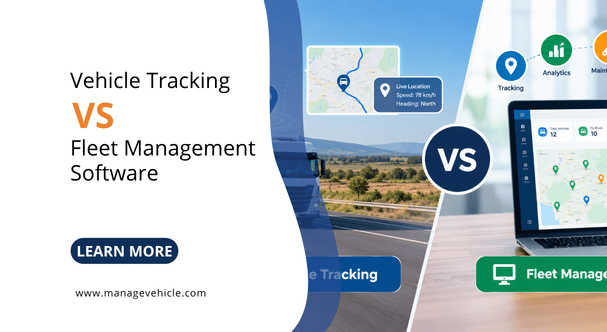
Vehicle tracking vs fleet management software is one of those comparisons that sounds like splitting hairs until you actually need to buy something. Right now they get used interchangeably in a lot of marketing copy, and that’s honestly a bit misleading.
If you’re trying to work out which one your business actually needs, the short version is this: vehicle tracking tells you where a vehicle is. Fleet management software tells you where it is, whether it’s due for a service, whether the driver’s fatigue hours check out, and whether you’ve got the paperwork to prove all of that to an auditor if it ever comes to that.
What Vehicle Tracking Actually Is
Vehicle tracking answers one question. Where is this vehicle, right now or at some point in the past? A GPS tracker logs location, and most units these days also grab speed and basic route history. You get a live map, a trail of everywhere the vehicle’s been, and usually an alert if it wanders outside an area you’ve set.
That’s genuinely handy on its own. It’s good for proof of delivery, checking a route was actually followed, recovering a stolen vehicle, or just knowing where things are without ringing every driver. But it’s a fairly narrow slice of what running a fleet involves, especially once heavy vehicles and compliance requirements come into it.
Some people call this telematics, and the terms do overlap a lot in everyday use. Strictly speaking, telematics covers a bit more ground again, since it usually pulls in engine diagnostics and driver behaviour data alongside the location piece. Either way, it’s still one layer below the full fleet management picture.
What Fleet Management Software Actually Is
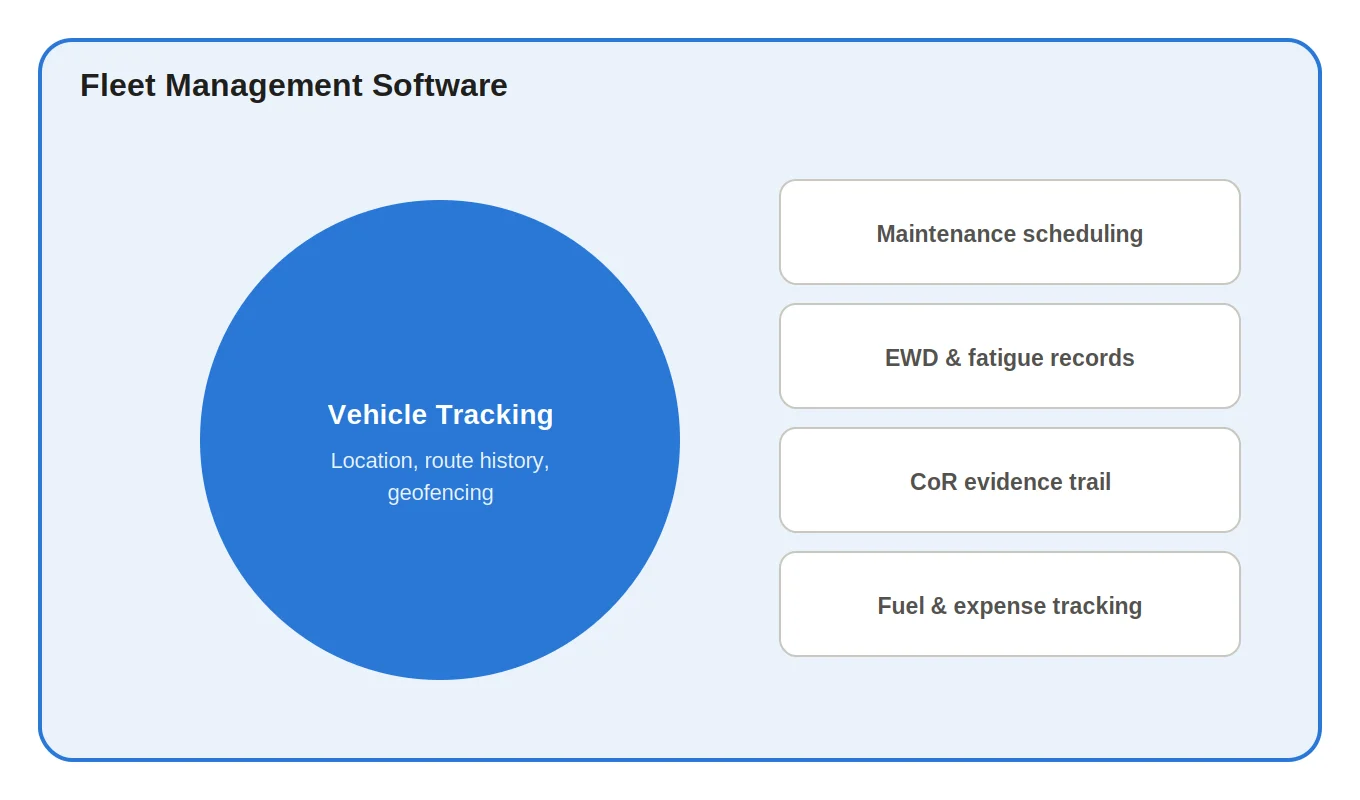
Fleet management software is the fuller operational platform. Vehicle tracking sits inside it as a base layer, and everything else gets built on top: maintenance scheduling tied to odometer or engine-hour readings, fuel and expense tracking, driver behaviour scoring, document storage, and for Australian heavy vehicle operators specifically, compliance tools like Electronic Work Diaries, fatigue records, and Chain of Responsibility evidence.
You notice the difference the moment something actually goes wrong. A vehicle tracker will tell you a truck was speeding. Fleet management software tells you the truck was speeding, flags whether that driver’s done it before, checks it against their work diary for a possible fatigue link, and keeps the whole record somewhere an NHVR auditor can actually use it.
Some platforms package the driver-behaviour side of this into what’s called an in-vehicle monitoring system, or IVMS. It’s not a separate category so much as a specific way of describing that layer within fleet management software.
Vehicle Tracking vs Fleet Management Software: Side-by-Side
| Vehicle Tracking | Fleet Management Software | |
|---|---|---|
| Live location and route history | Yes | Yes |
| Geofencing and movement alerts | Usually | Yes |
| Driver behaviour scoring | Rarely | Yes |
| Maintenance scheduling | No | Yes |
| Fuel and expense tracking | No | Yes |
| Electronic Work Diary/fatigue records | No | Often built in |
| Chain of Responsibility (CoR) evidence | No | Yes |
| Document and compliance reporting | No | Yes |
| Fine for a single ute or small light fleet | Often, yes | A bit much, but it scales |
| Suits heavy vehicles under the HVNL | Not on its own | Built for this |
Why This Actually Matters in Australia
The vehicle tracking vs fleet management software question gets a lot more serious once heavy vehicles and HVNL compliance are involved.
For any fleet running vehicles over 4.5 tonnes GVM, this isn’t just a feature comparison. It’s a compliance question. Under the Heavy Vehicle National Law, Chain of Responsibility parties have to manage safety “so far as is reasonably practicable,” and since the 2026 reforms, that gets assessed using the PSOE method: whether your systems are Present, Suitable, Operating, and Effective.
A standalone tracker can show where a truck was. That’s useful evidence something happened. What it generally can’t show is fatigue compliance, maintenance history, or a documented safety management system, which is exactly what gets examined in an audit. If your fleet includes any heavy vehicles, tracking alone won’t get you through a PSOE-based HVA audit. You need the wider platform.
For light vehicle fleets with no HVNL exposure, that calculation looks different. A good tracker might genuinely cover everything you need, at least until the fleet grows or takes on heavier vehicles.
Which One Do You Actually Need?
Three questions worth asking yourself.
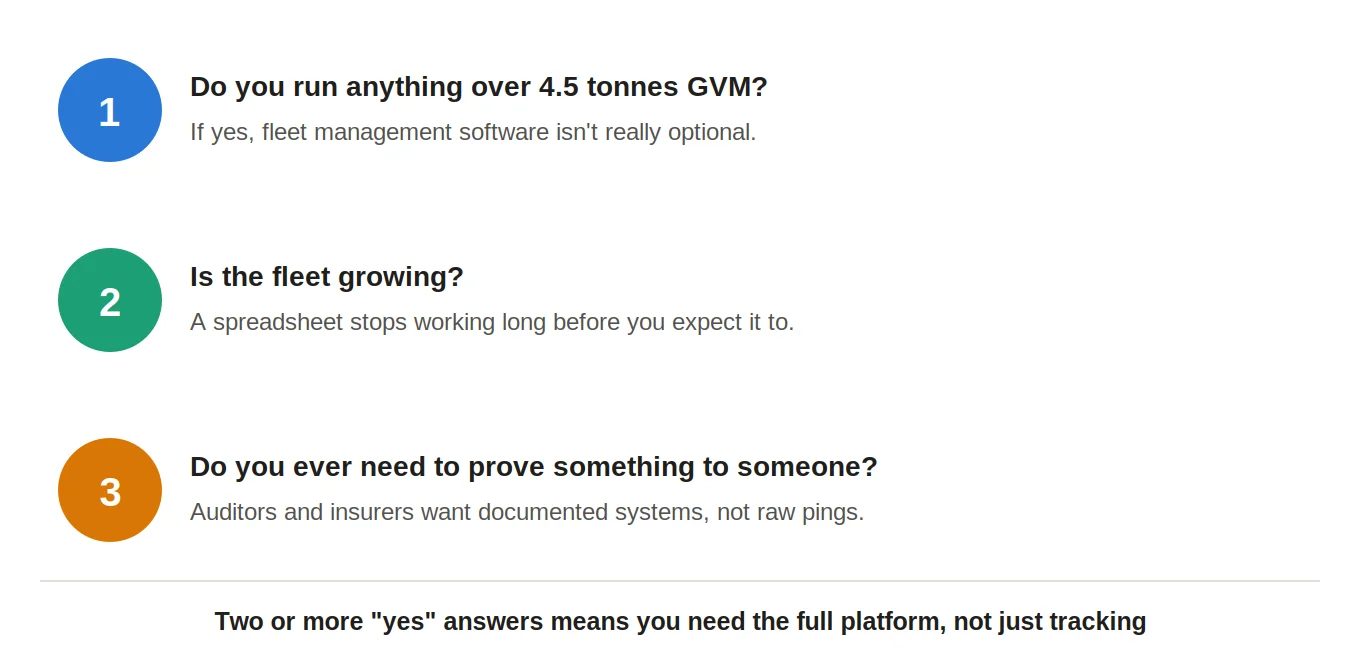
Do you run anything over 4.5 tonnes GVM? If yes, fleet management software isn’t really optional. The compliance side alone rules out standalone tracking.
Is the fleet growing? Two vehicles might be fine on tracking alone. Fifteen vehicles with a mix of light and heavy assets need the operational layer that fleet management software adds, since manual tracking in a spreadsheet stops being workable pretty quickly.
Do you ever need to prove something to someone? Insurers, auditors, councils, courts. They increasingly want documented systems, not just raw location pings. If you’d ever need to show what you knew and what you did about it, that’s a fleet management function, not a tracking one.
The Bottom Line
Vehicle tracking isn’t really competing with fleet management software. It’s a feature that’s already inside it. The real question isn’t tracking versus software, it’s whether you only need location data, or whether you need the compliance, maintenance, and reporting layer built around it too. For any fleet with heavy vehicles or real compliance exposure, that question tends to answer itself.
If you’ve landed on fleet management software as the answer, our guide to choosing GPS fleet tracking software in Australia goes through what’s actually worth looking for before you sign anything.
FAQ
Is vehicle tracking the same as fleet management software?
No. Vehicle tracking is one feature (knowing where a vehicle is). Fleet management software is the broader platform, and it includes tracking plus maintenance, compliance, fatigue management, and reporting tools.
Can I use just a vehicle tracker for my heavy vehicle fleet?
Not really, on its own. Heavy vehicle operators under the HVNL need documented compliance evidence (fatigue records, maintenance history, CoR trails) that standalone trackers don’t provide. A basic tracker can support that evidence, but it can’t replace the broader system an audit actually looks for.
When is standalone vehicle tracking enough?
For small fleets of light vehicles with no HVNL exposure, a decent tracker can genuinely do the job, particularly if all you need is location and basic route history.
Does fleet management software cost more than vehicle tracking alone?
Usually, yes, since it covers more ground. But for a fleet with compliance obligations, the real comparison isn’t tracking versus software. It’s the cost of the platform against the cost of failing an audit or a CoR investigation without one.
Do all fleet management platforms include vehicle tracking?
Yes. Vehicle tracking (GPS location, route history) is a baseline feature of pretty much every fleet management platform. It doesn’t work the other way around. Most standalone GPS trackers don’t include the wider compliance and maintenance tools fleet management software has.