
Government fleet management for Australian councils means running a mixed fleet of light vehicles, trucks, mowers, sweepers, and plant under tighter compliance rules, smaller budgets, and more public scrutiny than a private operator will ever face. If your council operates anything over 4.5 tonnes GVM, you have Chain of Responsibility obligations under the Heavy Vehicle National Law (HVNL), and from 1 August 2026, those obligations got harder to satisfy with paper records alone. This guide covers what council fleet coordinators actually need to get right: HVNL compliance, FBT logbooks, vehicle utilisation, EV transition planning, and procurement.
Why Council Fleets Are Different from Private Fleets
A council fleet coordinator manages a range of assets no commercial operator would recognise as a single fleet. Waste trucks, parks maintenance utes, graders, road patching trucks, pool cars for building inspectors, and sometimes a community bus. Each asset class has different compliance requirements, different maintenance cycles, and often a different department paying for it.
We see three things that catch councils off guard compared to private operators.
First, councils are CoR parties under the HVNL whether they think of themselves as “transport companies” or not. If your council directs an employee to drive a waste truck or haul road construction plant on a heavy vehicle, you are performing the functions of an operator, scheduler, and often a loading manager under the law. IPWEA Fleet has been running programs to raise awareness of this, but in practice, many council fleet coordinators only learn about their CoR obligations after the NHVR sends an inquiry.
Second, accountability works differently. Every dollar your council spends on fleet is ratepayer money. Internal auditors, councillors, and the public can FOI your maintenance spend, fuel costs, and vehicle utilisation data. A private fleet manager who parks an underused ute in the depot for six months faces a conversation with their boss. A council fleet coordinator faces a question at a council meeting.
Third, fleet decisions are slow. Procurement goes through panels and tender processes. Vehicle replacement programs need capital budget approval, sometimes years in advance. When the rules change, as they did on 1 August 2026, councils can’t pivot the way a 10-truck private operator can.
HVNL Compliance Obligations for Councils (Updated August 2026)
The Heavy Vehicle National Law Amendment Act 2025, passed by Queensland Parliament on 18 November 2025, commenced on 1 August 2026 with no grace period. This is the biggest change to heavy vehicle regulation in over a decade, and it applies to every council operating heavy vehicles in NSW, Victoria, Queensland, South Australia, Tasmania, and the ACT. Western Australia and the Northern Territory operate under separate state/territory law.
Here is what changed for councils specifically.
The primary duty now bites harder. Every party in the Chain of Responsibility, including councils as operators and schedulers, must ensure the safety of their transport activities so far as is reasonably practicable. The 2026 amendments make it clear that a documented pattern of non-compliance, even without an incident, can be used as evidence of a primary duty failure. You do not need a crash to be prosecuted. You need a documented failure to take reasonable steps.
Safety Management Systems are now mandatory for accredited operators. If your council holds NHVAS accreditation (now transitioning to the new Heavy Vehicle Accreditation scheme), you need a documented SMS that addresses your transport activities and the controls you use to manage risk. The 2026 Master Code of Practice, released by the NHVR in January 2026, lists 45 transport activities, over 70 hazards, and more than 500 recommended controls. Courts can use the Master Code to assess what “reasonably practicable” looks like. If your council’s SMS does not reference it, that gap will be visible in an audit.
The “unfit to drive” duty is new and broader than you think. Under expanded Section 228(1), drivers of all heavy vehicles over 4.5 tonnes GVM now have a positive duty to be fit to drive, covering fatigue, illness, injury, mental health, medication, alcohol, and drugs. This replaced the old fatigue-only duty that applied only to vehicles over 12 tonnes. For councils running waste trucks, road maintenance vehicles, and community buses, this means every driver of a vehicle over 4.5 tonnes GVM must be assessed as fit before they start work. A verbal “you right to drive today, mate?” is not a system. You need a documented process.
SMS audit findings are now admissible as court evidence. If your council’s Safety Management System is audited and the auditor finds gaps, those findings can be used in CoR breach proceedings. This is a significant shift. Under the old framework, accreditation audits and CoR prosecutions operated in largely separate lanes. Now they converge.
CoR penalties after 1 July 2026 CPI indexation: Category 1 (reckless conduct) carries a maximum penalty of $4,230,550 for a body corporate and $436,850 plus up to 5 years imprisonment for an individual. Category 2 maxes out at $2,120,880 corporate and $212,090 individual. Category 3 is $705,820 corporate and $70,580 individual (as of July 2026, per the NHVR penalty schedule). Council executives, not just fleet coordinators, carry personal liability under the due diligence duty in Section 26D.
Insider observation: We regularly see councils that have strong WHS documentation for their depot and office operations but treat their fleet as a separate silo. The HVNL doesn’t care about your org chart. If your council’s WHS team has never looked at your fleet’s CoR obligations, your SMS almost certainly has a gap that an NHVR auditor will find using the PSOE (Present, Suitable, Operating, Effective) audit method. The most common gap we find when onboarding a council fleet is that their loading procedures for waste trucks exist in a supervisor’s head, not in a documented system.
FBT and Electronic Logbooks for Council Vehicles
Fringe Benefits Tax is one of the largest hidden costs in council fleet management, and one of the most auditable. The FBT year runs from 1 April to 31 March. For the year ending 31 March 2027, the FBT rate is 47{a1ecdeac7aa669694223042b5414f4ebc99bf67e8f4841ec62bf1bd690e4433f}, unchanged from the past several years.
Most councils default to the statutory formula method for calculating FBT on vehicles available for private use, because it requires less record-keeping. The statutory rate is 20{a1ecdeac7aa669694223042b5414f4ebc99bf67e8f4841ec62bf1bd690e4433f} of the car’s base value, regardless of how much private use actually occurs.
The operating cost method, which calculates FBT on actual private use, almost always produces a lower FBT liability for councils with mostly-business-use vehicles. But it requires a valid 12-week logbook meeting ATO requirements: start and end date of each journey, start and end odometer readings, kilometres travelled, and purpose of each trip. That logbook must be maintained for a continuous 12-week period and can be relied on for up to four years if usage patterns don’t materially change.
Here is where most councils leave money on the table: manual paper logbooks are so unreliable that finance teams default to the statutory method rather than risk an invalid logbook. Electronic logbooks, when they hold an ATO class ruling, eliminate this problem. The logbook runs automatically from GPS data, the driver classifies trips as business or private, and the system generates compliant records. For a council running 30 pool cars and utes, the FBT savings from switching to the operating cost method with electronic logbooks can run to six figures per FBT year.
Insider observation: The ATO is explicit that a logbook entry recorded as just “business” without a destination or purpose does not meet substantiation requirements. We have seen council logbooks rejected on audit because drivers entered “depot to site” for every trip without specifying which site. An electronic logbook solves this by capturing GPS coordinates automatically, but the driver still needs to classify the trip correctly. Build the classification step into your daily vehicle checkout process, not at the end of the week when nobody can remember where they went.
Vehicle Utilisation and Right-Sizing Your Council Fleet
Utilisation data is the single most powerful tool a council fleet coordinator has, and it is the one most councils collect poorly or not at all.
A common benchmark: if a vehicle is used less than 60{a1ecdeac7aa669694223042b5414f4ebc99bf67e8f4841ec62bf1bd690e4433f} of available working hours, you should be asking whether it needs to exist as a dedicated asset or whether it can be shared across departments through a pool booking system. We have seen councils with vehicles sitting in depot yards for weeks at a time because one department “owns” it on paper, even though they only need it three days a week. Another department hires an identical vehicle from an external provider because they don’t know the first one is available.
Telematics data makes this visible. Trip history, idle time, and after-hours use all feed into a utilisation picture that supports two things: operational efficiency in the current fleet, and evidence for the next vehicle replacement business case.
Right-sizing matters for EV planning too. Before you commit capital to replacing ICE vehicles with EVs, you need accurate data on daily travel distances, idle time, and return-to-depot patterns. An EV with 400km range is fine for a building inspector doing metro rounds. It may not suit a rural shire’s road maintenance crew covering 250km return trips to remote worksites with no charging infrastructure.
Insider observation: Council fleet reports prepared for budget meetings often show total kilometres driven per vehicle per year. That number alone is misleading. A vehicle that does 25,000km per year might be a parks ute driven every day on short trips, or it might be a community bus that does two long trips per month and sits idle the rest of the time. Break the data down to daily utilisation, not annual totals, and your replacement decisions become defensible.
EV Transition Planning for Council Fleets
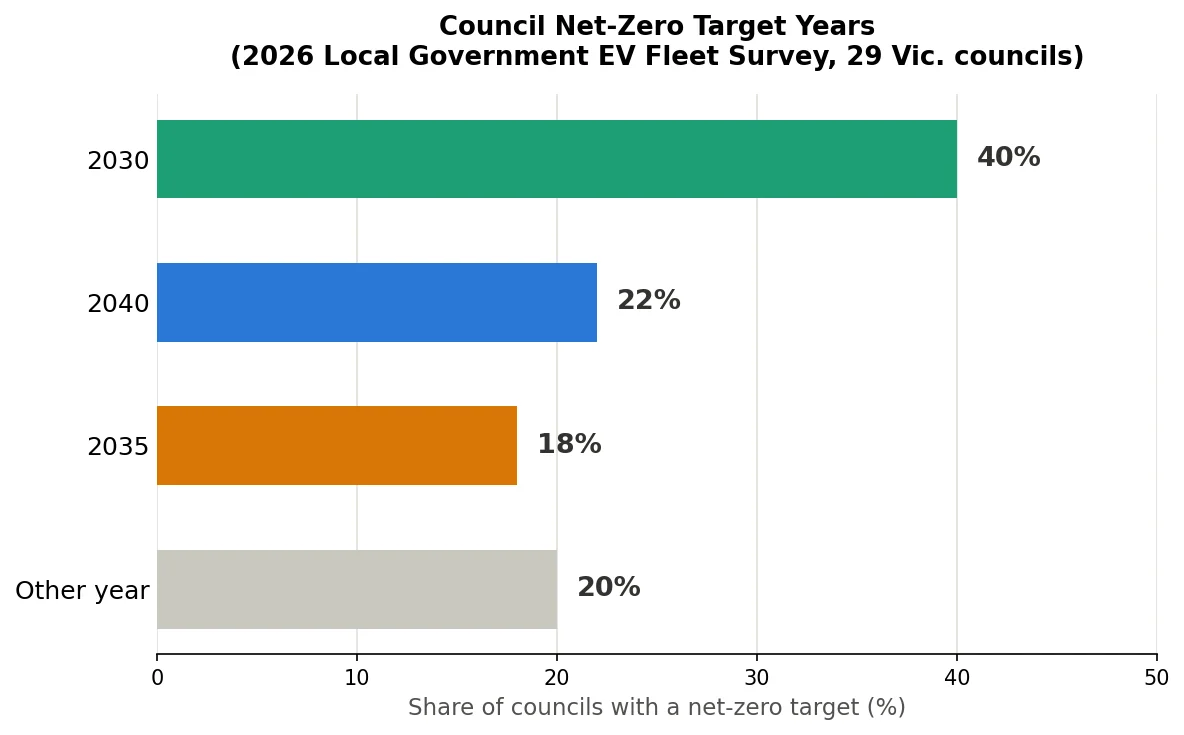
Council EV transition is accelerating across Australia. The 2026 Local Government EV Fleet Survey, completed by 29 Victorian councils, found that 80{a1ecdeac7aa669694223042b5414f4ebc99bf67e8f4841ec62bf1bd690e4433f} of participating councils have adopted a formal net-zero target, with the most common target year being 2030 (40{a1ecdeac7aa669694223042b5414f4ebc99bf67e8f4841ec62bf1bd690e4433f} of respondents), followed by 2040 (22{a1ecdeac7aa669694223042b5414f4ebc99bf67e8f4841ec62bf1bd690e4433f}) and 2035 (18{a1ecdeac7aa669694223042b5414f4ebc99bf67e8f4841ec62bf1bd690e4433f}).
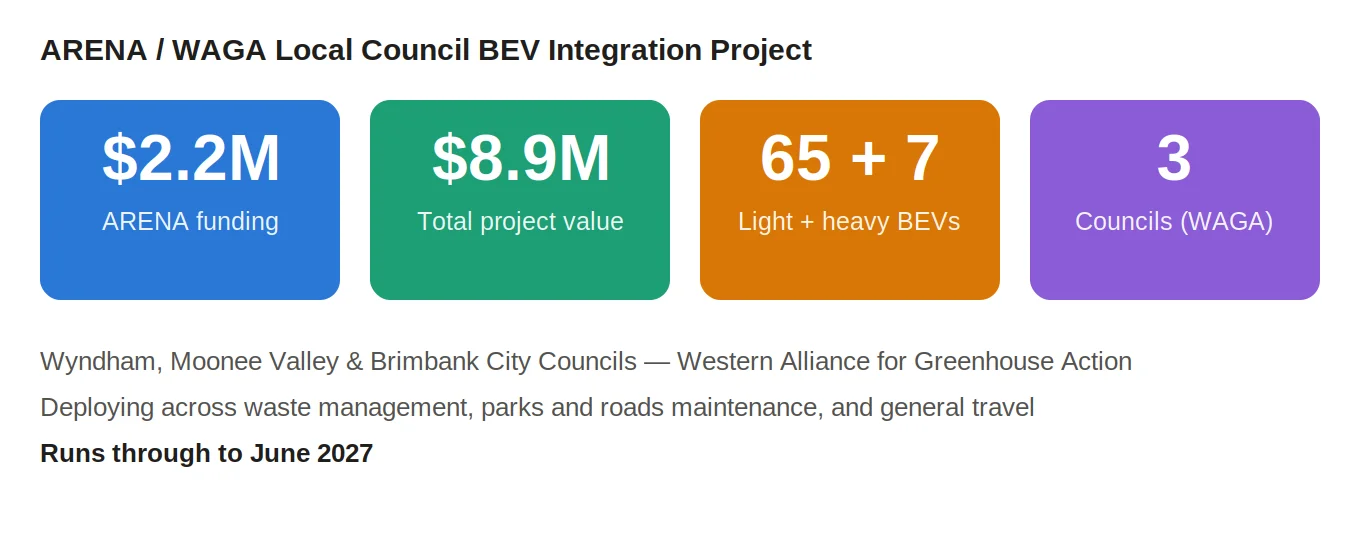
The Victorian Government’s EV Charging for Council Fleets program funded the installation of 122 electric vehicle charging stations within 55 council sites across Victoria. The federal government, through ARENA, provided $2.2 million to Western Melbourne councils — Wyndham City Council, Moonee Valley City Council, and Brimbank City Council, members of the Western Alliance for Greenhouse Action (WAGA) — for the Local Council BEV Integration Project, deploying 65 light and 7 heavy battery electric vehicles plus charging infrastructure, at a total project value of $8.9 million, running through to June 2027.
The FBT exemption for eligible electric vehicles is a major incentive. Vehicles below the luxury car tax threshold that are zero- or low-emission are exempt from FBT, making salary-sacrificed EVs attractive for council staff.
But the practical challenges for councils are different from those facing commercial fleets. Council depots often have electrical infrastructure designed for the 1980s. Upgrading a depot to support 10 or 20 DC fast chargers is a capital project that competes with every other infrastructure priority your council is managing. Heavy and specialist vehicles, such as waste trucks, sweepers, and graders, have limited or no EV options in the Australian market today.
What to do now:
Start with your light vehicle fleet. Pool cars, building inspector vehicles, and administrative utes are the easiest wins. Get accurate utilisation and travel-distance data from telematics before writing a business case. Document charging requirements per vehicle class. Plan depot electrical upgrades as a staged project, not a single capital hit.
For heavy vehicles, watch the market but don’t wait. Document your current fleet emissions profile so you can show progress when councillors or community groups ask. The transition of waste trucks and heavy plant to electric is a 5-to-10-year horizon for most councils, not a next-budget-cycle decision.
Procurement: How Councils Buy Fleet Management Software
Council procurement follows rules that private operators can ignore. In NSW, Local Government Procurement (LGP) is a prescribed entity under legislation, meaning councils using LGP panel contracts do not need to independently tender for values above the tendering threshold. This saves significant time, but it also means your choice of fleet management provider may be limited to whoever is on the relevant panel.
When writing an RFQ for fleet management or telematics, council fleet coordinators should cover:
Data sovereignty. Where is fleet data stored? For a council managing ratepayer-funded assets, data hosted offshore creates privacy and governance risks. Look for Australian-hosted data centres.
Cost-centre reporting. Council fleets serve multiple departments. Your system needs to allocate fuel, maintenance, and utilisation costs by department and cost centre, not just by vehicle.
Mixed-fleet support. You are running light vehicles, heavy vehicles, mowers, sweepers, and possibly boats or generators. A system designed for long-haul transport will not handle that range.
Integration with existing systems. Councils typically run asset management, finance, and WHS systems that predate any fleet software purchase. Your fleet platform needs to integrate or, at minimum, export data in formats those systems accept.
Privacy and workplace monitoring. Since June 2025, Australia has a new statutory tort for serious invasions of privacy under the Privacy and Other Legislation Amendment Act 2024. Covert GPS tracking or location data misuse can trigger it. NSW passed the Digital Work Systems Act on 12 February 2026, which creates a positive duty to risk-assess the psychosocial impact of digital monitoring, including vehicle tracking. Victoria’s Surveillance Devices Act 1999 was amended in December 2025. Council fleet coordinators need to ensure their tracking policies are documented, disclosed to employees, and proportionate.
Common Mistakes Council Fleet Coordinators Make
1. Treating CoR as someone else’s problem. We have seen councils where the fleet coordinator assumed CoR obligations fell entirely on contracted waste collection operators. If your council directs the scheduling, route, or loading of a heavy vehicle, you are a CoR party regardless of who employs the driver.
2. No documented pre-start process for heavy vehicle drivers. The expanded unfit-to-drive duty means a supervisor needs to assess fitness before a driver starts work. A signed daily checklist, supported by a digital system that timestamps the record, is the minimum defensible position.
3. Running paperwork diaries when digital alternatives exist. The NHVR recorded approximately 5,000 fatigue offences in 2025 and launched Operation Ambit in March 2026 targeting fatigue and work diary breaches. Paper work diaries are error-prone and difficult to audit. Electronic Work Diaries remove transcription errors and provide real-time visibility into driver hours.
4. No maintenance evidence trail. Councils often maintain vehicles through internal workshops with mechanics who know the fleet inside out. The problem arises when an NHVR inspector asks for maintenance records and the workshop’s system is a whiteboard and a filing cabinet. Digital maintenance records with timestamps, photos, and sign-offs create an evidence trail that protects both the council and the mechanic.
5. Buying fleet software without checking utilisation data first. We have onboarded councils that purchased a telematics system for 80 vehicles, only to discover through utilisation data that they needed only 65. Right-size first, then buy.
Frequently Asked Questions (FAQ)
Do councils have Chain of Responsibility obligations under the HVNL?
Yes. If your council operates, schedules, loads, or directs heavy vehicles over 4.5 tonnes GVM, it performs CoR functions under the HVNL. This includes waste collection, road construction, plant transport, and any other activity involving heavy vehicles. Council executives carry personal liability under Section 26D.
What HVNL penalties apply to councils?
The same penalties that apply to any CoR party. As of July 2026, maximum penalties range from $705,820 (Category 3, body corporate) to $4,230,550 (Category 1, body corporate). Individual officers face fines up to $436,850 and up to 5 years imprisonment for Category 1 reckless conduct offences. Verify current figures against the NHVR penalty schedule, as amounts are CPI-adjusted annually.
Can councils use electronic logbooks for FBT?
Yes, provided the electronic logbook system holds an ATO class ruling confirming it meets the definition of logbook and odometer records for FBT purposes. The logbook must cover a continuous 12-week period and include journey dates, odometer readings, kilometres, and trip purpose. A valid electronic logbook can be relied on for up to four FBT years.
How should councils manage the EV transition for their fleets?
Start with accurate utilisation and travel-distance data from your existing fleet. Transition light vehicles first, where EV range and charging infrastructure are proven. Plan depot electrical upgrades in stages. For heavy vehicles and specialist plant, document your emissions profile and monitor market availability, but do not commit capital until suitable models are available and tested in Australian council operating conditions.
Is GPS tracking of council vehicles legal?
Yes, when implemented with proper workplace policies. Councils must notify employees, implement role-based access controls, set clear data retention periods, and ensure tracking is used for legitimate operational purposes. NSW, Victoria, and the Commonwealth each have specific surveillance and privacy legislation that governs how tracking data is collected, stored, and used. The 2025-2026 amendments to federal and state privacy laws have increased obligations around digital workplace monitoring.
What does the 2026 HVNL “fit to drive” duty mean for council drivers?
From 1 August 2026, drivers of all heavy vehicles over 4.5 tonnes GVM must be fit to drive, covering fatigue, illness, injury, mental health impairment, medication effects, and substance impairment. This is broader than the previous fatigue-only duty and applies at a lower vehicle weight threshold. Councils need a documented fitness-to-drive assessment process for all heavy vehicle drivers before each shift.
What should a council RFQ for fleet management software include?
At minimum: Australian data hosting, cost-centre reporting across departments, mixed-fleet capability (light vehicles, heavy vehicles, plant, and specialist assets), integration with existing council finance and asset systems, compliance reporting for HVNL and WHS obligations, and transparent pricing without long-term lock-in. Also address workplace monitoring and privacy requirements specific to your state.