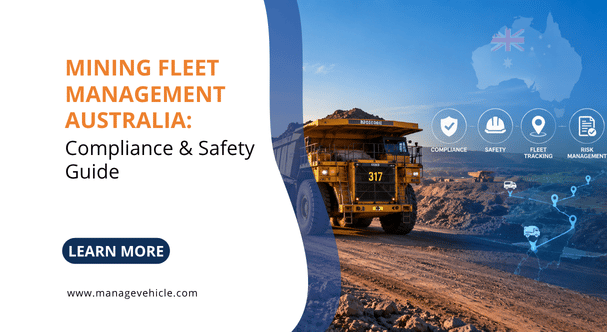
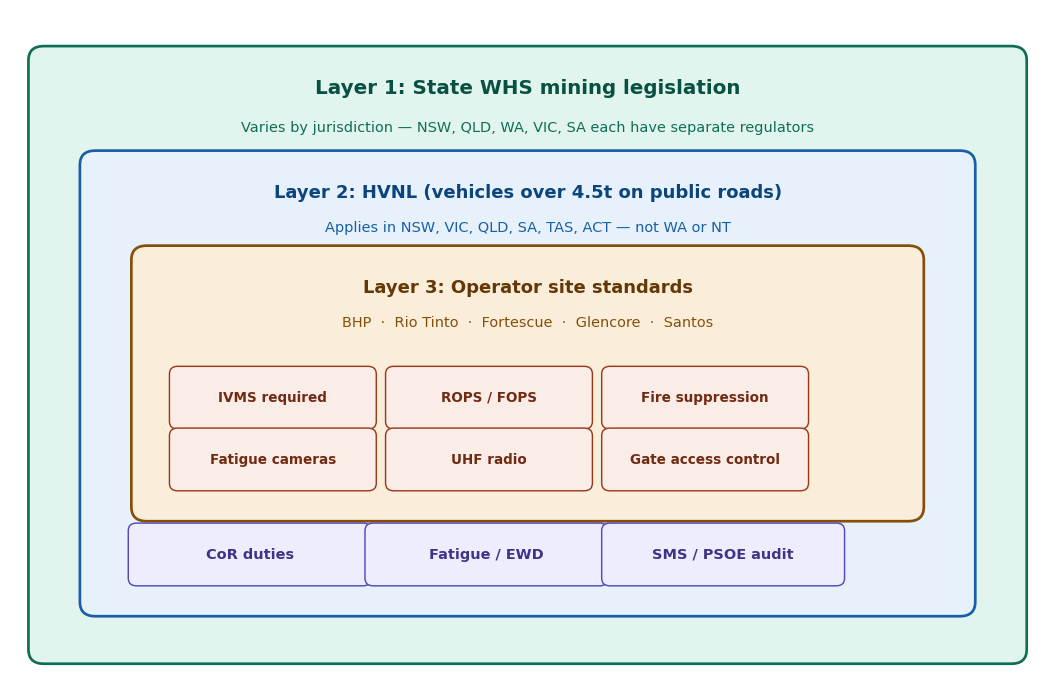
Mining fleet management Australia sits under two regulatory frameworks that apply simultaneously: state-based Work Health and Safety (WHS) mining legislation, and the Heavy Vehicle National Law (HVNL) for any vehicle over 4.5 tonnes GVM that touches a public road. On top of those, every major mine operator (BHP, Rio Tinto, Fortescue, Glencore, Santos) enforces their own site-specific vehicle standards, including mandatory In-Vehicle Monitoring Systems (IVMS), rollover protection, fire suppression, and driver fatigue monitoring. Operators who only prepare for one of these layers get caught by the others.
Mining fleet compliance is harder than general transport compliance for one reason: there is no single national standard. Safe Work Australia confirms that WHS in the mining industry is regulated by individual states and territories, not the Commonwealth. That means a contractor running 30 trucks across BHP sites in WA, coal operations in Queensland, and a metalliferous mine in NSW is dealing with three separate WHS regulators, each with different inspection manuals, reporting obligations, and enforcement approaches.
Layer the HVNL on top for any vehicle that drives between the mine gate and the depot, the 2026 HVNL reforms that introduced mandatory Safety Management Systems (SMS) and the PSOE audit standard, and each operator’s own mine-spec fit-out requirements, and you have a compliance environment that is genuinely difficult to manage without a connected system.
We work with construction and mining operators every week who assumed their general fleet management setup covered their mine fleet. It almost never does. Here is what mining fleet management Australia actually requires.
WHS Mining Regulations by State
There is no uniform national WHS code for mining vehicles. Each state regulator sets its own requirements, and the differences are material enough that you cannot apply a Queensland compliance approach to a Western Australian site.
New South Wales: The Resources Regulator under the Department of Regional NSW administers the Work Health and Safety (Mines and Petroleum Sites) Act 2013 and the WHS (Mine and Petroleum Sites) Regulation 2022. The Regulation identifies principal hazards and control plans for specific consideration. The NSW Resources Regulator publishes quarterly safety reports. The January to March 2026 report documented a near-miss where a dump truck narrowly avoided a collision with a light vehicle at a T-intersection because priority road rules were not enforced with signage. Vehicle interaction incidents like this are a recurring theme in NSW mine safety data. MDG 15 (Mobile and Transportable Equipment for Use in Mines) is the primary technical reference for surface and underground vehicle safety in NSW.
Queensland: The Coal Mining Safety and Health Act 1999 and the Mining and Quarrying Safety and Health Act 1999 govern separately. Queensland’s Mines Inspectorate publishes individual mine site safety performance data going back years, and the state has historically recorded some of the highest rates of high-potential incidents (HPIs) involving vehicles. Queensland Guidance Note QGN 16 specifically addresses fatigue risk management for mining.
Western Australia: WorkSafe WA administers the WHS Act 2020 for the mining sector. WA’s fatigue management code of practice for commercial vehicle drivers was originally approved under the Occupational Safety and Health Regulations and continues in effect under the WHS Act through transitional arrangements. WA is also the state with arguably the most stringent mine-spec vehicle requirements, because the largest tier-one operators (BHP, Rio Tinto, Fortescue) run most of their operations there.
Victoria: WorkSafe Victoria provides safety guidance for mines and quarries and enforces plant and equipment safety. Victorian mines tend to be smaller scale (quarries, extractives), but the compliance obligations are no less specific.
South Australia: The Department for Energy and Mining administers mining compliance. Operators require site-specific vehicle standards, pre-start checks, and evidence of equipment tagging and maintenance.
The practical takeaway: your fleet management system needs to be configurable by site and by jurisdiction. A single set of pre-start inspection templates will not satisfy a Queensland coal mine and a WA iron ore operation simultaneously.
HVNL Obligations for Mining Vehicles on Public Roads
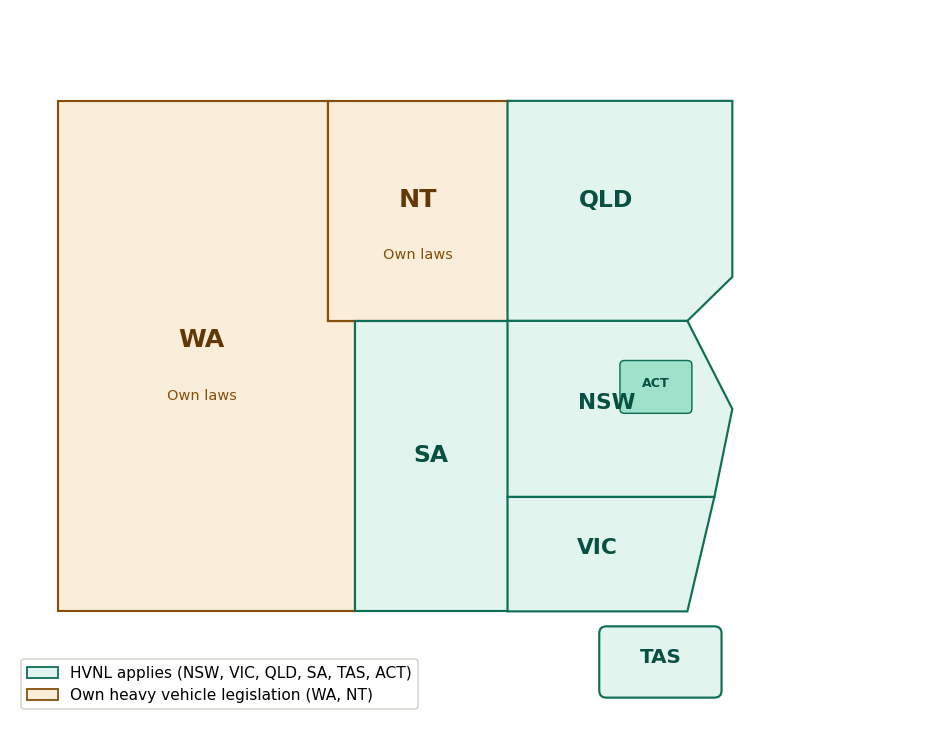
Any mining vehicle over 4.5 tonnes GVM that drives on a public road falls under the HVNL. This applies across NSW, VIC, QLD, SA, TAS, and ACT. WA and NT operate under their own heavy vehicle legislation.
This catches more operators than people expect. The haul truck that never leaves the mine site is one thing. The 20-tonne rigid that delivers fuel from the depot to the site, the water cart that drives 40 km on a state highway between two pits, the bus carrying workers from town to the mine gate – every one of those is a fatigue-regulated heavy vehicle the moment it touches a public road.
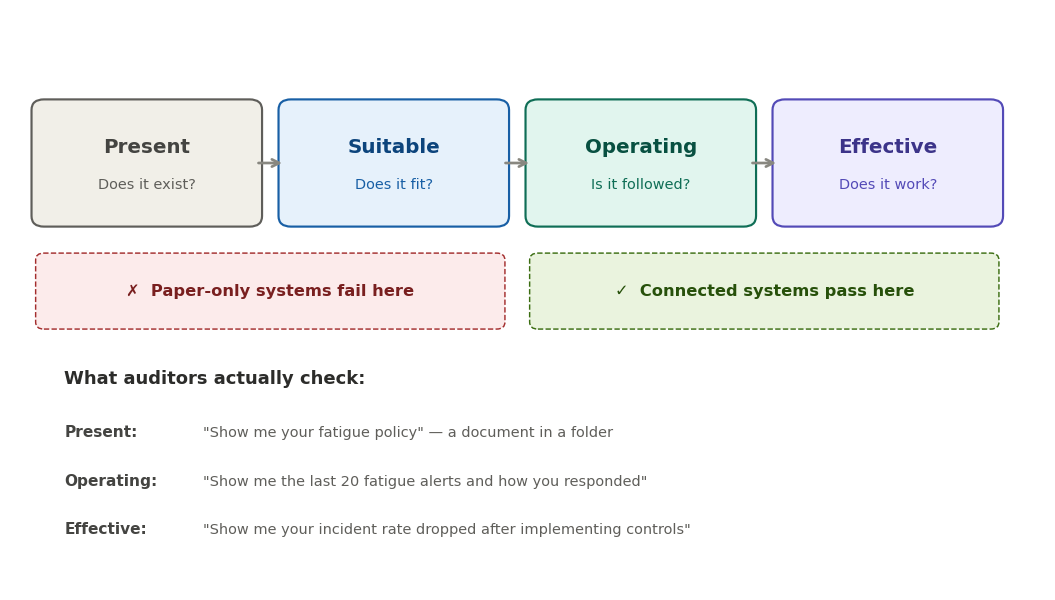
Since 1 August 2026, the HVNL reforms require every accredited heavy vehicle operator to maintain a documented, auditable Safety Management System. Audits under the new Heavy Vehicle Accreditation (HVA) scheme use the PSOE method: Present, Suitable, Operating, and Effective. A paper system in a binder satisfies “Present” at best. To clear “Operating” and “Effective,” your records need to show that the system is followed in daily work and producing measurable safety outcomes.
For mining operators, the Chain of Responsibility (CoR) provisions are especially relevant. CoR does not stop at the operator. Schedulers, consignors, loaders, and anyone who exercises control or influence over a transport task shares legal responsibility. Penalties for the most serious CoR breaches reach $4,230,550 for corporations and $436,850 plus up to five years imprisonment for individuals (as of 1 August 2026, post-CPI indexation).
Insider note: We see mining contractors trip on the CoR boundary constantly. The site manager who schedules a truck to leave the mine at 4am to make a 7am delivery 300 km away has just scheduled a fatigue risk on a public road. If that driver breaches fatigue hours, the scheduler and the business are both exposed. The HVNL does not care that the scheduling happened on a mine site. It cares that the driving happened on a public road.
Mining Fleet Management Australia: Mine-Spec Vehicle Requirements and IVMS
There are no universal mine-spec vehicle standards across Australia. Each mining company publishes its own vehicle specification document, and those specs vary between operators, between sites, and sometimes between contracts on the same site.
That said, most mine-spec fit-outs address the same core safety risks:
- Rollover protection structures (ROPS) and falling object protective structures (FOPS).
- Fire suppression systems or extinguishers.
- In-Vehicle Monitoring Systems (IVMS) with GPS tracking and driver behaviour logging.
- UHF two-way radio, programmed to site channels.
- Flashing beacon or light bar.
- Three-point seatbelts for all occupants.
- First aid kit.
- High-visibility markings and mine site identification decals.
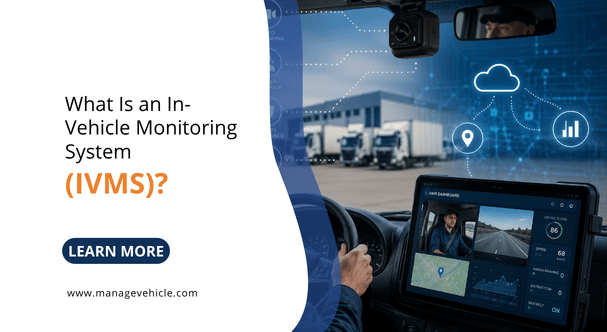
IVMS is now a near-universal requirement for both light and heavy vehicles on major Australian mine sites. An IVMS typically combines GPS location tracking, speed monitoring, harsh braking and acceleration detection, geofencing alerts, and journey management data. At tier-one sites, IVMS data must be accessible to the mine operator in real-time or near-real-time, and the telemetry provider and reporting cadence must be documented and approved.
For vehicles carrying nine or more occupants (common in crew buses running FIFO workers from airstrips to camp), BHP’s requirements add electronic stability control (ESC), anti-lock braking systems (ABS), a journey risk management plan for all travel routes, and driver competency verification.
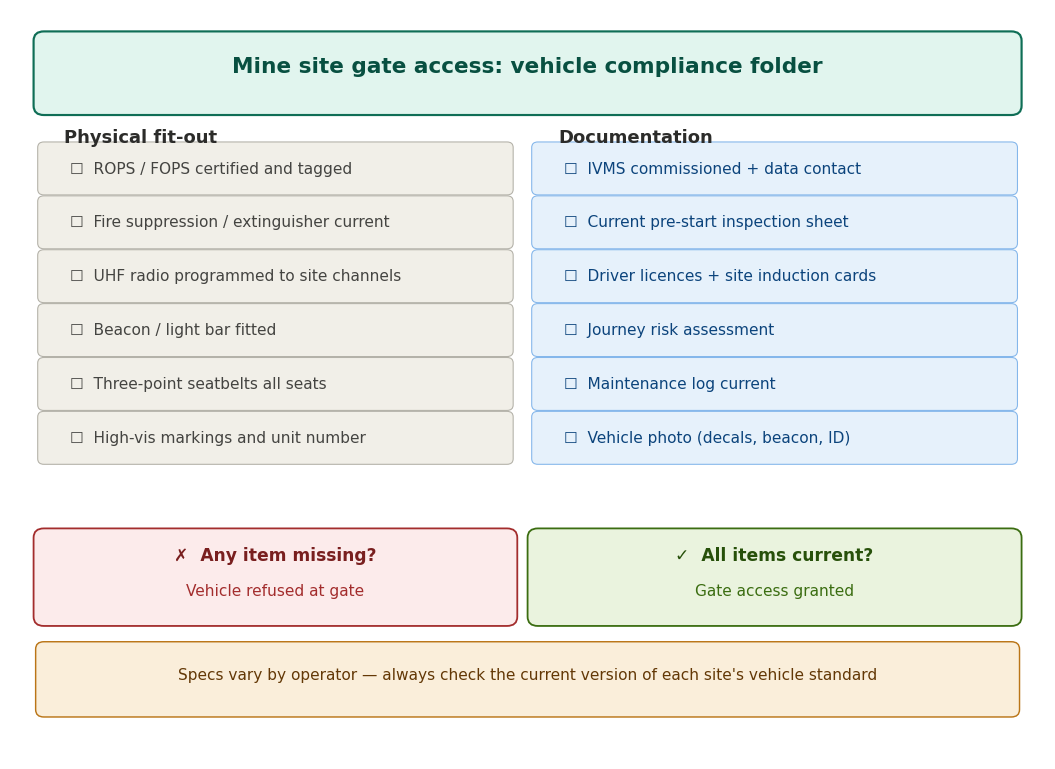
Gate access is the enforcement mechanism. If your vehicle documentation is incomplete, your IVMS is not commissioned, or your fit-out does not match the operator’s spec, you will be refused entry at the gate. Every day a vehicle sits outside the gate waiting for a compliance issue to be resolved is a day of lost revenue.
What to keep in each vehicle’s digital compliance folder:
- Photo of the whole vehicle showing decals, beacon, and unit number.
- IVMS commissioning certificate and contact details for data access.
- UHF radio with proof of programming.
- Fire extinguisher inspection tags and current pre-start inspection sheet.
- Driver licences, site induction cards, and journey risk assessment.
- Maintenance log and any ROPS or seatbelt certification.
Fatigue Management for Mining and FIFO Operations
Fatigue is the single biggest safety risk in mining fleet operations. Safe Work Australia data shows that vehicle incidents have consistently been the leading cause of fatal workplace injuries in the mining sector, and the pattern continued through 2025
Mining fatigue risk is compounded by factors that do not exist in standard transport operations. Extended 12-hour shifts. Compressed FIFO rosters that disrupt circadian rhythm. Night work across multiple consecutive days. Extreme heat, vibration, and monotony that contribute to physical and mental exhaustion. Research cited by multiple Australian regulators, including Safe Work Australia, shows that a fatigued worker can experience cognitive impairment equivalent to a blood alcohol concentration of 0.05, which is the legal driving limit in Australia.
For vehicles over 4.5 tonnes on public roads, the HVNL fatigue management framework applies directly. Standard Hours, Basic Fatigue Management (BFM), and Advanced Fatigue Management (AFM) each set specific work and rest limits. Drivers operating more than 100 km from their nominated base must record work and rest hours in a National Driver Work Diary or an NHVR-approved Electronic Work Diary (EWD). Records must be retained for three years.
The 2026 HVNL reforms expanded the old fatigue-only duty into a broader “unfit to drive” obligation under Section 228(1). This now covers fatigue, illness, injury, medication effects, mental health conditions, and substance use for all heavy vehicles over 4.5 tonnes GVM. The penalty for failing to comply with the unfit-to-drive duty is $26,610 per offence (as of 1 August 2026).
On site, WHS legislation requires employers to manage foreseeable fatigue risks regardless of vehicle weight. There is no 100 km radius exemption on a mine site. Queensland’s Guidance Note QGN 16 specifically addresses fatigue risk management in mining and quarrying. Victoria’s WorkSafe publishes dedicated fatigue guidance for mines. In WA, the code of practice for fatigue management of commercial vehicle drivers applies.
AI-powered driver fatigue and distraction monitoring systems (DFMS or DFDM) are now standard across many Australian mining fleets. These use in-cab cameras with machine learning to detect eye closure, yawning, head position, and mobile phone use. When a risk event is detected, the system alerts the driver in real-time and notifies the fleet manager or a 24/7 response centre.
Insider note: Installing fatigue detection hardware is not the same as managing fatigue. In a well-documented NHVR investigation involving a WA-based heavy vehicle fitted with fatigue detection technology, the system recorded hundreds of camera misalignments over several weeks because the driver was repositioning the camera to avoid monitoring. The vehicle subsequently rolled and caught fire, resulting in a fatality. Under the PSOE framework, a system that generates alerts nobody responds to fails at “Operating.” The full details of this case and what it means for dashcam compliance are covered in our IVMS guide.
GPS Tracking and Remote Area Connectivity
Mining operations present a connectivity challenge that does not exist in urban or even regional transport. Vehicles regularly operate outside mobile coverage areas, underground, or across sites that span hundreds of square kilometres.
A GPS tracking system for a mining fleet needs to handle three scenarios:
Full cellular coverage: Standard GPS tracking with real-time position updates, speed monitoring, and geofencing works normally. Most tracking platforms provide this out of the box.
Intermittent or no cellular coverage: The tracking hardware must store data locally and sync automatically when connectivity returns. If your system drops data every time a vehicle enters a dead zone, you have gaps in your compliance trail. An auditor looking at your speed or fatigue records will ask about those gaps.
Underground operations: GPS signals do not penetrate underground. Zone-based tracking using proximity sensors, beacons, or mesh networks is required to maintain vehicle and personnel visibility below ground.
Satellite connectivity (typically Iridium) is available as an add-on for most IVMS platforms and is effectively mandatory for fleets operating in the Pilbara, the Goldfields, or remote NT and SA locations. Without it, you lose real-time visibility of your vehicles and drivers exactly when and where the risk is highest.
Geofencing is not optional for mining. Every mine site has defined operational zones, exclusion areas, blast zones, and haul routes. Your tracking system should enforce these boundaries with automated alerts when a vehicle enters or exits a restricted area.
Fuel Tax Credits and Off-Road GPS Data
Fuel tax credits (FTC) are one of the most significant financial benefits available to mining fleet operators, and one of the most under-claimed. The ATO provides FTC for fuel tax (excise or customs duty) included in the price of fuel used in machinery, plant and equipment, heavy vehicles over 4.5 tonnes, and light vehicles travelling off public roads or on private roads.
For mining operations, most fuel use is off-road by definition. Mine site access roads, haul roads, pit areas, and privately constructed roads all qualify as off-road travel. The off-road FTC rate is the full excise rate, not reduced by the road user charge.
Important note on 2026 rate changes: Fuel tax credit rates changed multiple times in 2026, with temporary reductions applying across several months before rates reverted to full levels in August 2026. The practical impact on a fleet burning 10,000 litres per quarter can run into thousands of dollars depending on which rate applies. Use the ATO’s official fuel tax credit calculator for every claim. Do not apply last quarter’s rate to this quarter’s fuel.
GPS tracking is the critical enabler for accurate FTC claims. Without GPS data that distinguishes between public road travel and off-road or private road use, you are either under-claiming (leaving money on the table) or making estimates that will not survive an ATO review. A GPS system that automatically classifies travel as on-road or off-road based on mapped geofences gives you auditable evidence for every litre claimed.
Businesses can claim FTC retrospectively for up to four years through their BAS. For mining operators who have been running GPS tracking but not using the data for FTC, this represents a significant recovery opportunity. Manage Vehicle’s fuel and expenses analytics captures on-road and off-road classification automatically, giving you the data trail the ATO expects.
Common Compliance Gaps in Mining Fleet Management Australia
These are the failures we see most often when onboarding mining and construction fleet operators.
Running mine-site vehicles under a general fleet system that does not account for site-specific requirements. A pre-start inspection template designed for a line-haul truck will miss ROPS certification, fire suppression checks, IVMS status, and UHF radio functionality. Every mine site needs its own inspection workflow, and that workflow needs to match the operator’s current vehicle standard document – not the version from two years ago.
Treating on-site and on-road compliance as separate problems. The same vehicle that hauls overburden on site might drive 80 km on a state highway to reach the depot for servicing. The moment it hits the public road, HVNL fatigue rules, work diary obligations, CoR duties, mass and dimension limits, and speed management requirements all activate. If your driver was on their tenth hour of a 12-hour site shift and then drives home on a public road, you may already have a fatigue breach. Your system needs to track total hours, not just on-road hours.
No documented journey risk management. Most tier-one sites require a journey management plan for any travel outside the mine site boundary. Many operators treat this as a form to fill in at the gate and then ignore. An effective journey plan captures the route, the expected travel time, rest stops, communication check-ins, and fatigue risk factors. GPS tracking with automated check-in alerts turns a paper exercise into an active safety control.
Under-claiming fuel tax credits because off-road data is not captured. If your telematics system does not automatically distinguish between public and private road use, your FTC claims are either estimated or absent. Both are problems. Estimates that cannot be backed by data are vulnerable to ATO review. Absent claims mean you are paying fuel tax on off-road use that the law entitles you to recover.
Failing to update vehicle compliance documentation when site specs change. Mining operators update their vehicle standards periodically. BHP, Rio Tinto, and Fortescue all revise their requirements independently. If your compliance folder for a vehicle references a superseded specification, you risk being turned away at the gate. Track HSE document revision dates for each operator you work with, and re-certify when they update.
How Manage Vehicle Reduces Mining Fleet Compliance Risk
Every gap listed above comes down to the same root problem: mining fleet compliance generates obligations across WHS, HVNL, and site-spec layers simultaneously, and a disconnected system – spreadsheets, email chains, paper folders – cannot keep those layers in sync.
Offline-capable GPS tracking solves the remote-area visibility problem. Manage Vehicle’s tracking hardware stores data locally and syncs automatically when connectivity returns, so there are no gaps in your speed, location, or fatigue records when a vehicle operates outside mobile coverage. For FTC claims, the same GPS data automatically classifies travel as on-road or off-road, giving you the auditable evidence the ATO requires.
Site-configurable pre-start inspections solve the template mismatch problem. A vehicle assigned to a BHP site runs a BHP-spec checklist. A vehicle that moves to a Fortescue site the following week runs a Fortescue-spec checklist. The inspection workflow matches the operator, not a generic default.
Smart dashcams with AI-powered fatigue and distraction detection solve the “hardware installed, nobody acting on the data” problem. Every alert, every driver acknowledgement, and every corrective action is logged. Under the PSOE framework, that audit trail is the difference between a system that is merely “Present” and one that is “Operating” and “Effective”- which is exactly what an NHVR auditor or WHS inspector will test.
Consolidated compliance reporting across fatigue management, maintenance, mass, incidents, and driver documentation means that when a WHS inspector asks to see the maintenance history and pre-start records for vehicle #14 across the last six months, you produce it in minutes not days.
Frequently Asked Questions (FAQs)
What regulations apply to mining fleet vehicles in Australia?
Mining fleet vehicles are governed by state-based WHS mining legislation (which varies by jurisdiction), the HVNL for any heavy vehicle over 4.5 tonnes operating on public roads (in NSW, VIC, QLD, SA, TAS, and ACT), and the specific vehicle standards set by each mine site operator. All three layers apply simultaneously.
Do mining vehicles need IVMS in Australia?
There is no single national law mandating IVMS for all mining vehicles. In practice, IVMS is a near-universal requirement at tier-one mining sites. BHP, Rio Tinto, Fortescue, Glencore, and Santos all require IVMS (GPS tracking and driver behaviour logging) for contractor and company vehicles. Without a commissioned and approved IVMS, most major sites will refuse gate access.
How does fatigue management work for mining FIFO workers?
For vehicles on public roads, the HVNL fatigue management framework applies (Standard Hours, BFM, or AFM work and rest limits, plus work diary obligations for drivers operating more than 100 km from their base). On site, state WHS legislation requires employers to manage fatigue as a foreseeable safety risk regardless of vehicle type. The 2026 HVNL reforms also introduced a broader “unfit to drive” duty covering fatigue, illness, medication, and mental health for all heavy vehicles over 4.5 tonnes.
Can mining fleet operators claim fuel tax credits?
Yes. The ATO provides fuel tax credits for fuel used in eligible business activities, including off-road use on mine sites, private access roads, and heavy vehicle auxiliary equipment. The off-road rate is the full excise rate. GPS tracking data that distinguishes on-road from off-road travel is the most reliable evidence for supporting FTC claims. Businesses can claim retrospectively for up to four years via their BAS. Rates changed multiple times in 2026, so always use the ATO’s fuel tax credit calculator for the correct rate on the date the fuel was acquired.
What is the penalty for a CoR breach involving a mining vehicle on a public road?
Penalties follow the HVNL’s three-category structure. As of 1 August 2026, the maximum court-imposed penalties for Chain of Responsibility breaches are: Category 1 (reckless conduct) up to $4,230,550 for corporations and $436,850 plus up to five years imprisonment for individuals; Category 2 up to $2,120,880 for corporations; Category 3 up to $705,820 for corporations. These figures reflect July 2026 CPI indexation. The new unfit-to-drive penalty is $26,610 per offence.
Does the HVNL apply to mining vehicles in Western Australia?
No. The HVNL does not apply in WA or the NT. Western Australia has its own heavy vehicle legislation and WHS mining regulations under the WHS Act 2020. However, if a WA-based mining contractor operates vehicles in NSW, QLD, VIC, SA, TAS, or the ACT, the HVNL applies to those vehicles while operating in those jurisdictions. Operators running cross-border must comply with both frameworks.
What happens if a vehicle fails a mine site gate inspection?
The vehicle is refused entry until the compliance issue is resolved. This typically means the vehicle must be re-fitted, re-inspected, or have its documentation updated before re-presenting. Every day outside the gate is lost productive time. Operators who maintain digital compliance folders with current certifications, IVMS commissioning records, and site-specific pre-start sheets avoid this.