An In-Vehicle Monitoring System (IVMS) is a hardware and software platform installed in a vehicle to track its location, speed, and driver behaviour in real time. IVMS goes beyond basic GPS tracking by monitoring harsh braking, acceleration, cornering, seatbelt use, idling, geofence violations, and safety events. In Australia, IVMS is mandatory for site access on virtually every tier-one mining and energy operation. For heavy vehicle operators on public roads, IVMS data provides the auditable evidence that the HVNL’s Chain of Responsibility (CoR) provisions and the 2026 Safety Management System (SMS) requirements increasingly demand.
The simplest way to understand what IVMS does: GPS tracking tells you where a vehicle is. IVMS tells you where it is, how it got there, who was driving, and whether they did it safely.
That distinction matters. A basic GPS tracker drops a pin on a map. An IVMS platform records that the driver exceeded the site speed limit by 12 km/h in Zone C at 2:47 pm, braked harshly three times on the haul road, and triggered a geofence alert when the vehicle entered a blast exclusion area. That data sits in a timestamped log that can be produced for an auditor, a WHS investigator, or a court.
For operators running fleets across transport, construction, mining, or waste management, the practical question is not whether IVMS exists. It is whether your current tracking setup captures enough data to satisfy the compliance frameworks that now govern how Australian fleets operate.
How an In-Vehicle Monitoring System (IVMS) Works
An IVMS installation has two components: hardware in the vehicle and a software platform that receives, processes, and displays the data.
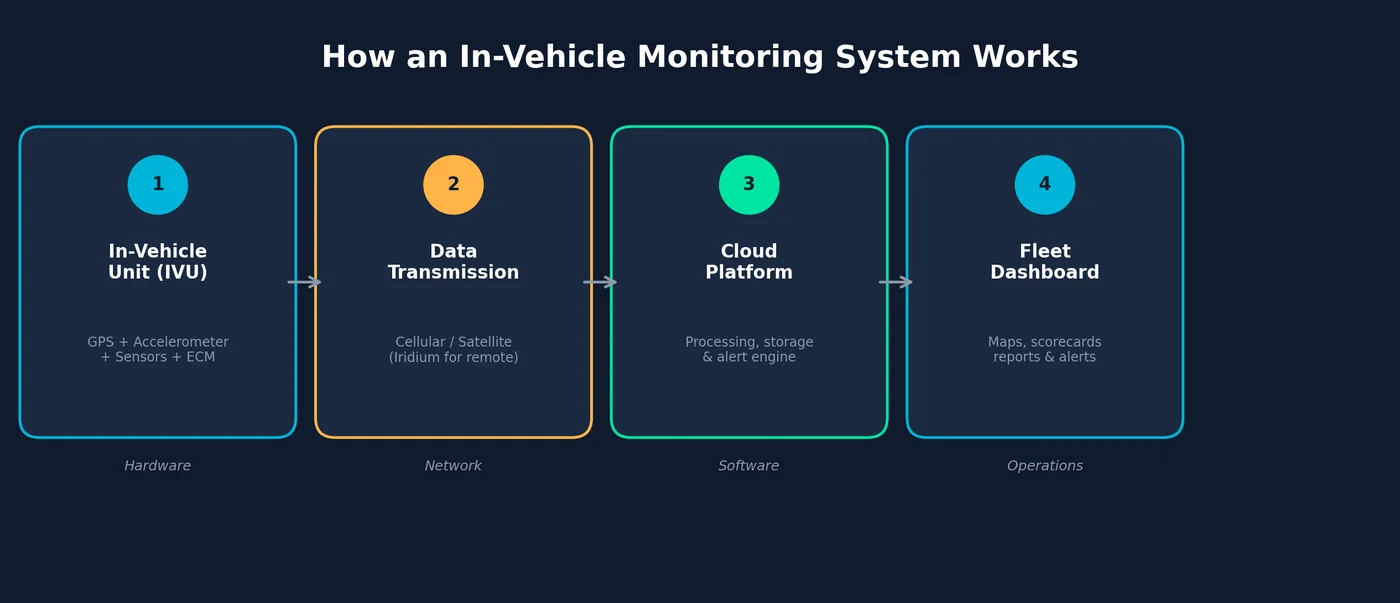
Hardware. The in-vehicle unit (IVU) is a ruggedised device wired into the vehicle’s electrical system. It contains a GPS receiver for positioning, an accelerometer for detecting harsh driving events, a cellular modem for transmitting data, and inputs for connecting additional sensors. Depending on the configuration, those additional sensors can include seatbelt switches, door sensors, engine diagnostics via the ECM (Engine Control Module) or OBD port, temperature probes, on-board mass sensors, and connections to driver identification systems such as iButton or NFC fobs.
When the ignition is on, the IVU records position, speed, heading, and sensor data at defined intervals. The Safer Together IVMS Specification used across Australia’s coal seam gas industry requires data storage at minimum every 200 seconds or at every vehicle event, whichever is shorter. Tier-one mining operators typically require second-by-second or near-real-time data transmission.
In areas without cellular coverage (common across the Pilbara, Goldfields, remote NT, and inland Queensland), the IVU stores data locally and syncs when connectivity returns. For operations that need continuous real-time visibility in remote areas, an Iridium satellite modem can be connected to the IVU so data transmits regardless of mobile coverage.
Software. The fleet management platform receives the data stream and presents it as live maps, trip replays, driver scorecards, exception reports, geofence alerts, and compliance dashboards. This is where IVMS becomes operationally useful. Raw GPS coordinates are meaningless. A dashboard that highlights the drivers with the most speed events this week, the vehicles with overdue pre-start inspections, and the route that consistently generates harsh braking alerts is where safety decisions happen.
IVMS vs GPS Tracking: What Is the Difference?
This question comes up constantly, and the honest answer is that the line is blurry. “GPS tracking” and “IVMS” and “telematics” are often used interchangeably, especially in the mining and resources sector where “IVMS” is the default term. In practice, industry practitioners across mining, oil, and gas treat IVMS as essentially interchangeable with telematics – the term is simply the default label for vehicle monitoring in the resources sector.
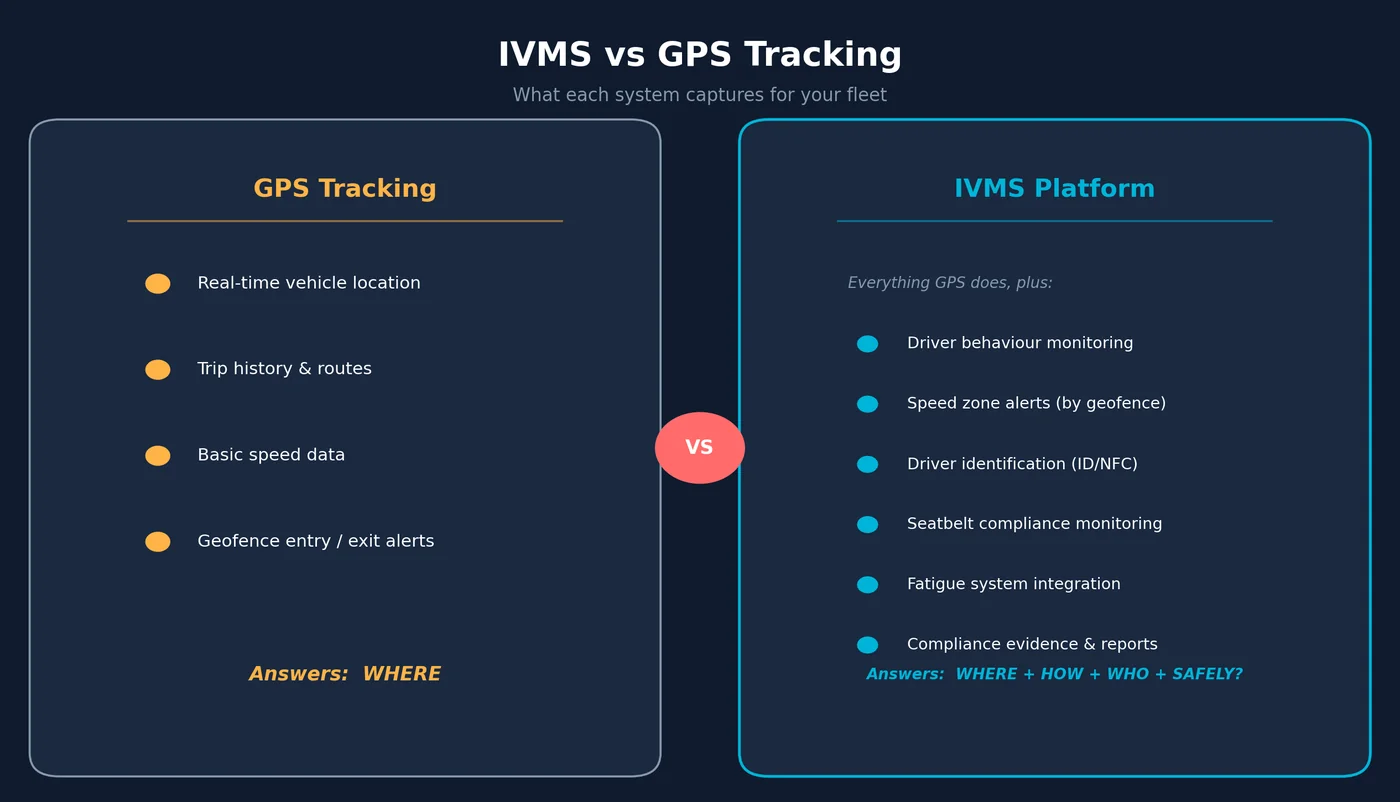
The functional differences matter more than the labels.
A standalone GPS tracker provides real-time vehicle location, trip history, basic speed data, and geofencing with entry and exit alerts. It answers the “where” question. It is enough for operators whose primary need is vehicle visibility and route management.
An IVMS platform provides everything GPS tracking does, plus driver behaviour monitoring (harsh braking, acceleration, cornering, speeding by zone), seatbelt compliance monitoring, driver identification, geofence-specific speed rules (different speed limits for different zones on the same site), event-based alerts with in-cab warnings, integration with fatigue and distraction monitoring systems (DFMS/DFDM), and configurable exception reporting that generates the compliance evidence auditors and investigators require.
The National Road Safety Partnership Program (NRSPP) published a discussion paper on IVMS that identifies the critical implementation factor: what you do with the data determines whether you meet your safety objectives. Collecting driver behaviour data and never reviewing it is worse than not collecting it at all, because you have created a record showing you were aware of the risk and took no action.
Insider note: We see this exact mistake in transport fleets, not just mining. An operator installs telematics to get the “we have a system” box ticked, runs it for 18 months, and never sets up a single alert rule or generates a driver behaviour report. Then a speed-related incident occurs on a public road. During the CoR investigation, the NHVR asks for the telematics data. The data shows 340 unactioned speed events across the fleet over the previous six months. That data just became prosecution evidence, not a compliance asset. Install the system, configure the alerts, and act on the exceptions. That is what IVMS is for.
Where IVMS Is Mandatory in Australia
There is no single national law that requires IVMS in every Australian vehicle. The obligation comes from three different sources, and which one applies depends on where and how the vehicle is used.
Mining and energy sites. IVMS is a near-universal access requirement at tier-one mining operations. BHP, Rio Tinto, Fortescue (FMG), Glencore, Santos, and BMA each publish vehicle specification documents that mandate IVMS with GPS tracking and driver behaviour logging for all contractor and company vehicles entering their sites. In 2025, BMA tightened requirements further, mandating that all light vehicles be fitted with IVMS, a handbrake alarm, and a VHF radio programmed to site specifications before entry.
The Safer Together industry body, whose members include Santos, QGC, Arrow Energy, and Origin Energy, has published a Common IVMS Specification that standardises IVMS settings across the Australian energy production industry. It covers speed management, seatbelt monitoring, fatigue management, harsh driving events, and reporting formats. Before this specification existed, contractors working for multiple operators in the same week faced different IVMS rules at every gate. The specification was developed specifically to fix that problem.
If your vehicle does not have a commissioned and approved IVMS unit when it arrives at the gate, it does not enter the site. The enforcement mechanism is that simple.
Heavy vehicle operators under the HVNL. The HVNL does not mandate IVMS by name. What it does mandate, since 1 August 2026, is a documented Safety Management System that demonstrably manages speed, fatigue, mass, maintenance, and CoR risks, assessed against the PSOE standard (Present, Suitable, Operating, Effective). The NHVR’s own regulatory advice confirms that compliance with the HVNL Primary Duty requires doing what is “reasonably practicable” to ensure safety. For a fleet running 20 or more heavy vehicles, an auditor assessing whether your speed management system is “Operating” and “Effective” will expect to see data. IVMS produces that data.
The 2026 Master Code of Practice, released by the NHVR in January 2026, identifies over 500 recommended controls across 45 transport activities. While the Master Code is not legally mandatory, courts may use it as a benchmark for what constitutes reasonably practicable steps. Multiple controls in the Master Code reference real-time vehicle monitoring, speed management systems, and driver behaviour data, which is IVMS by function if not by name.
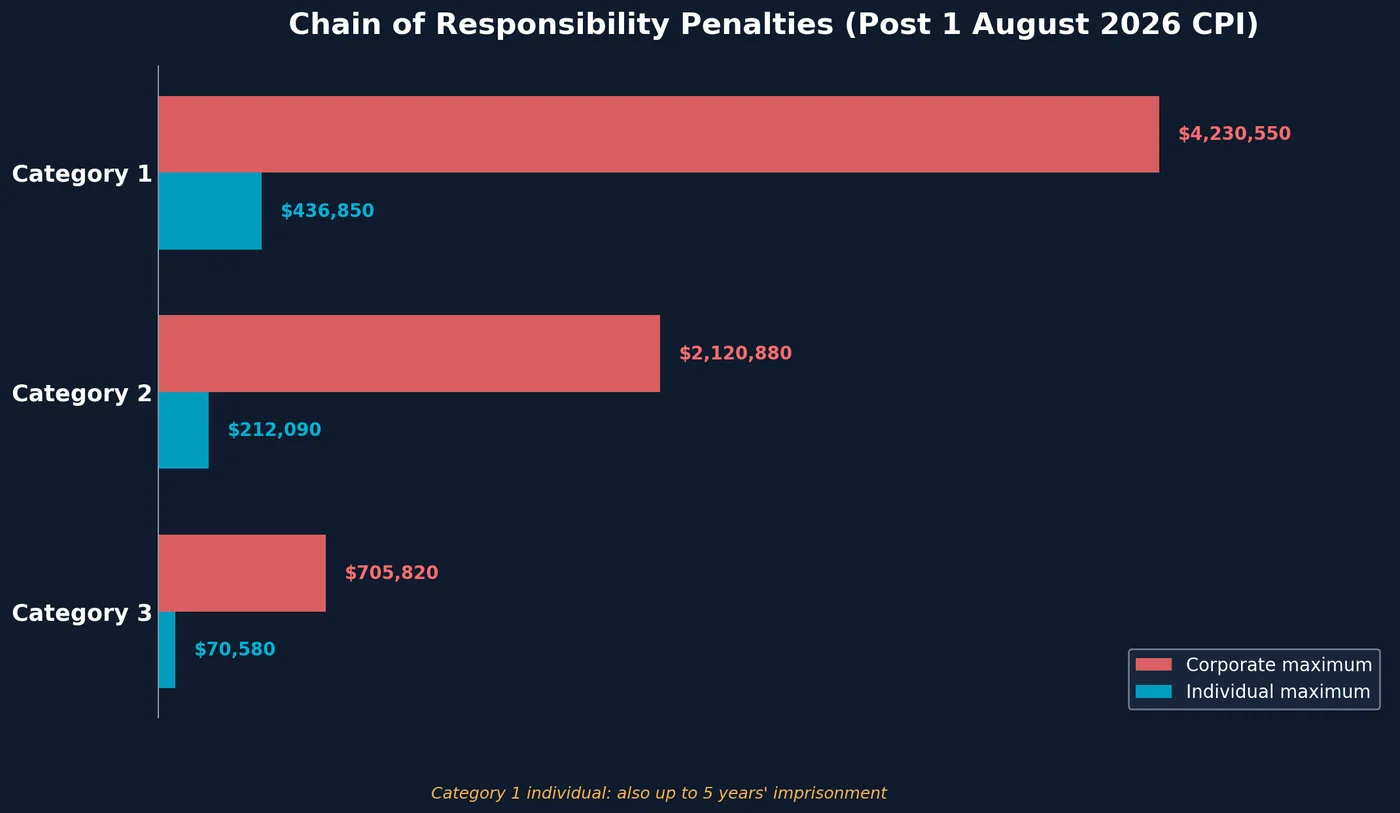
Corporate CoR penalties for the most serious breaches now reach $4,230,550 (as of 1 August 2026, post-CPI indexation). The due diligence duty under the HVNL applies personally to executive officers. An executive who cannot demonstrate their organisation took active steps to manage speed and fatigue risks faces personal fines up to $436,850 and up to five years’ imprisonment for a Category 1 breach, independently of the company penalty.
Workplace Health and Safety legislation. Under every state and territory WHS Act, a Person Conducting a Business or Undertaking (PCBU) has a primary duty of care to ensure, so far as reasonably practicable, that the health and safety of workers is not put at risk. For any business that operates vehicles as part of its work, managing foreseeable driving risks is part of that duty. The NHVR’s regulatory advice on WHS and CoR confirms that both duties must be complied with, and both emphasise proactive risk prevention. IVMS provides the documented evidence trail that your driving risk controls are in place and operating.
What Data Does an IVMS Capture?
The specific data points depend on your hardware configuration and the compliance standard you need to meet. A typical IVMS installation for an Australian transport or mining fleet captures the following:
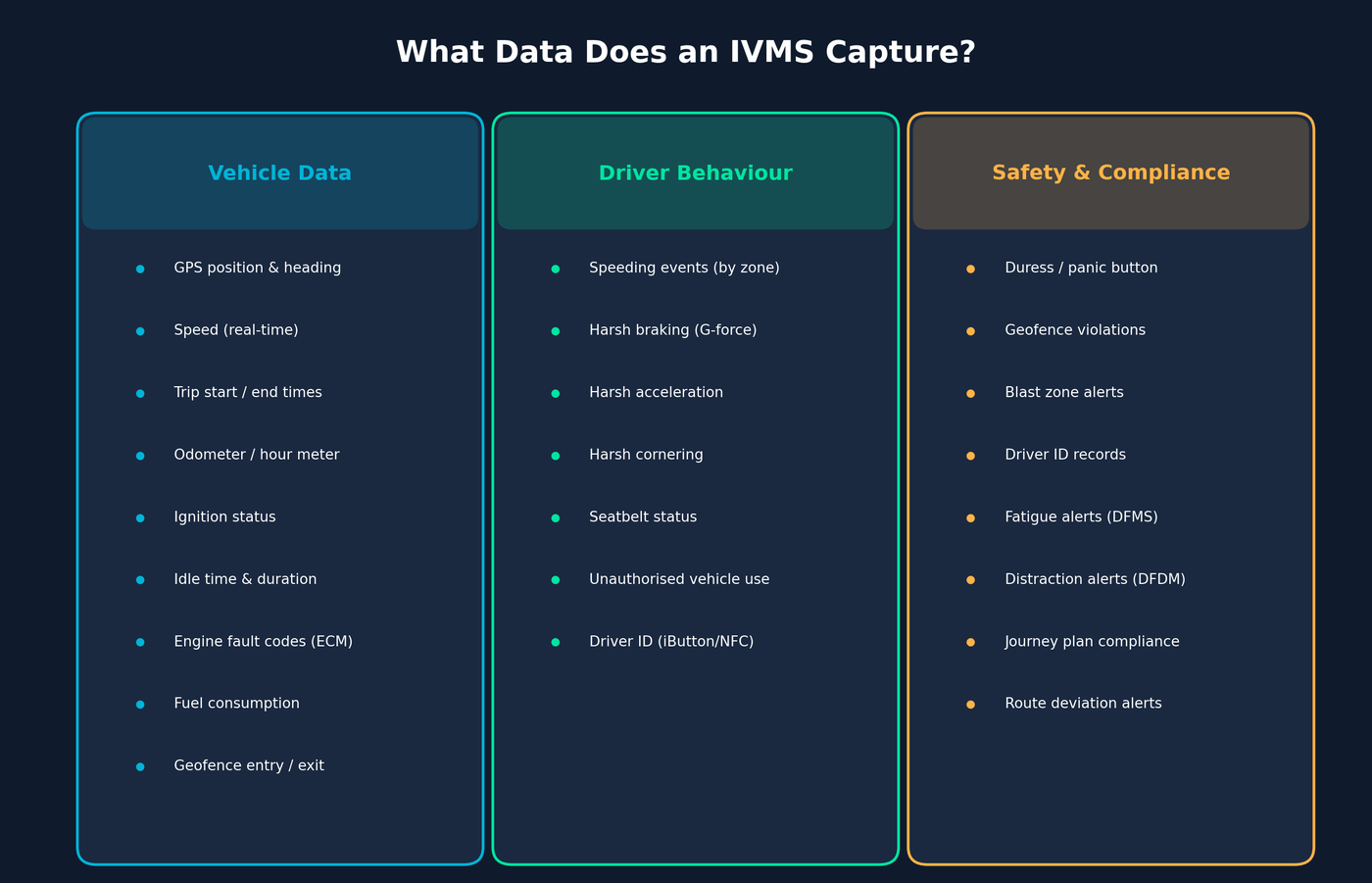
Vehicle data: Real-time GPS position, speed, heading, trip start and end times, odometer or hour meter readings, ignition status, idle time and duration, engine diagnostics (fault codes, fuel consumption, coolant temperature via ECM/OBD), and geofence entry and exit events with timestamps.
Driver behaviour data: Speeding events (above posted limit, above site-specific zone limit, or above a defined threshold), harsh braking events (measured by G-force from the accelerometer), harsh acceleration events, harsh cornering events, seatbelt status (buckled or unbuckled while vehicle is in motion), and unauthorised vehicle use (ignition on outside of defined operating hours or without a valid driver ID).
Safety and compliance data: Duress/panic button activations, geofence violations (vehicle enters a restricted zone, blast area, or exclusion area), driver identification records (which driver was operating which vehicle at what time), fatigue and distraction alerts (if integrated with a DFMS/DFDM camera system), and journey management plan compliance (vehicle deviated from approved route or failed to reach a checkpoint within the expected time).
Insider note: The data point that catches operators off guard most often is idle time. IVMS records every minute the engine runs without movement. When we onboard a fleet of 15 to 30 vehicles, the idle time report almost always reveals 20 to 40 minutes of unnecessary idling per vehicle per day. At current diesel prices, that adds up to thousands of dollars per year in wasted fuel across even a modest fleet. It is also a compliance issue: excessive idling in a loading area or depot can indicate scheduling pressure, which is a CoR red flag for fatigue and speed management.
IVMS for Heavy Vehicle CoR Compliance
The strongest compliance case for IVMS in Australian transport fleets is its role in meeting Chain of Responsibility obligations. CoR does not just apply to the driver. It extends to every party in the supply chain that exercises control or influence over how a heavy vehicle is used on a road: the operator, the scheduler, the consignor, the consignee, and the loader.
The HVNL’s primary duty requires each CoR party to ensure, so far as is reasonably practicable, that their conduct does not directly or indirectly cause or encourage a driver to contravene the law. “Reasonably practicable” is assessed against what the party knew, or should have known, and what was available to them.
IVMS directly supports three of the five CoR risk areas.
Speed management. IVMS records every speed event, timestamped and location-tagged. If a scheduler sets a delivery window that requires exceeding the speed limit, the IVMS data will show either that the driver exceeded the limit (evidence of the breach) or that deliveries consistently arrived late because the schedule was unrealistic (evidence the scheduler should review their planning). Either way, the data forces accountability.
Fatigue management. IVMS tracks driving hours, rest breaks, and vehicle movement patterns. When integrated with an Electronic Work Diary (EWD) or a DFMS camera system, it creates a complete picture of when a driver was working, how long they had been driving, and whether fatigue indicators were detected. The expanded “unfit to drive” duty under the amended HVNL, which since 1 August 2026 covers fatigue, illness, medication, and mental health for all heavy vehicles over 4.5 tonnes GVM (previously fatigue-only and only for vehicles over 12 tonnes), makes this data even more operationally relevant. The penalty for a single unfit-to-drive offence is $26,610.
Vehicle maintenance. IVMS platforms that pull engine diagnostics via ECM or OBD can flag fault codes, overheating, and abnormal operating conditions in real time. Linking that data to your maintenance scheduling system means defects are captured before a vehicle goes out with a known issue. Under CoR, an operator who dispatches a vehicle with a recorded unresolved fault is directly exposed.
Insider note: The CoR angle most operators miss is the scheduling evidence. We have worked with fleets where the IVMS trip data showed that drivers were consistently departing the depot 30 to 45 minutes late due to loading delays, then driving above the speed limit to make the delivery window. The speed events were a symptom. The root cause was a scheduling and loading problem that created pressure on the driver. IVMS data identified the pattern. Without it, the operator would have kept addressing individual speed events and never fixed the structural issue.
IVMS and the 2026 PSOE Audit Standard
Since 1 August 2026, operators with Heavy Vehicle Accreditation (HVA) are audited against the PSOE standard: Present, Suitable, Operating, Effective.
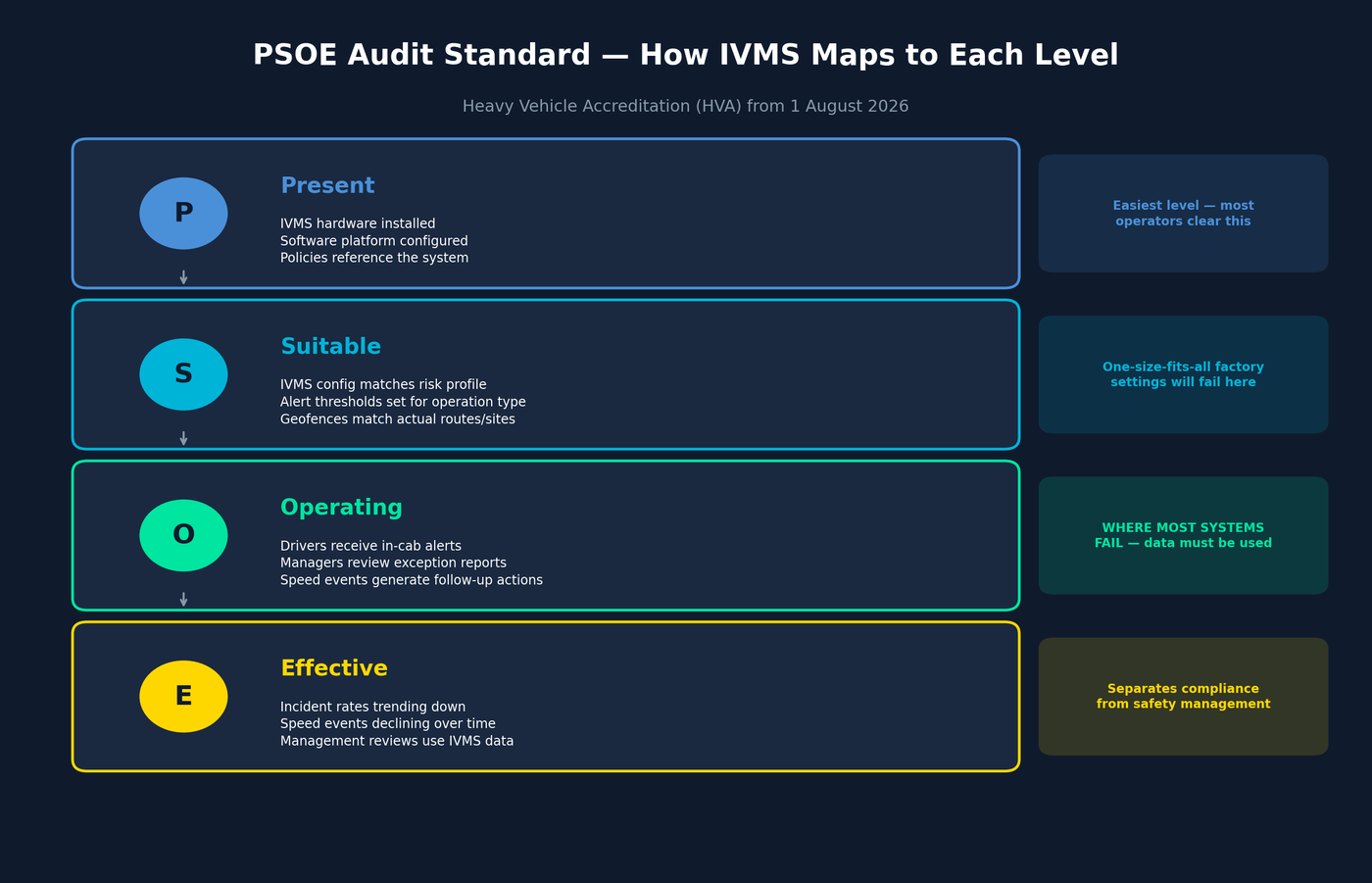
IVMS maps directly to each level.
Present: The IVMS hardware is installed and the software platform is configured. Policies reference the system and define how data is used. This is the easiest level to satisfy and the one most operators clear without trouble.
Suitable: The IVMS configuration matches the operation’s risk profile. A long-haul B-double fleet needs different alert thresholds, geofence structures, and reporting dashboards than a metropolitan rigid fleet running 50 km urban routes. A one-size-fits-all setup with factory-default settings will not clear “Suitable” for a fleet with specific fatigue, speed, or mass management risks.
Operating: This is where most systems fail. “Operating” means the IVMS data is being used in daily operations. Drivers are receiving in-cab alerts. Managers are reviewing exception reports. Speed events generate follow-up actions that are recorded. The system is not installed and ignored. Auditors look for evidence of active use: alert acknowledgement records, corrective action logs, driver coaching sessions triggered by IVMS data, and management review minutes that reference fleet performance trends from the platform.
Effective: The IVMS is producing measurable safety outcomes. Incident and near-miss rates are trending down. Speed event frequency is declining. Corrective actions are being closed out and verified. Management reviews show that decisions are being made based on IVMS data and those decisions are producing results. This is the level that separates compliance from genuine safety management.
A paper-based speed management policy with no data behind it clears “Present” at best. IVMS data that is collected but never reviewed clears “Present” and “Suitable” but fails “Operating.” A fully integrated IVMS platform with active alerts, documented follow-up actions, and quarterly management reviews of fleet safety trends is the system that clears all four levels.
How to Choose an IVMS for Your Fleet
The choice depends on where your vehicles operate, which compliance standards you need to meet, and how many vehicles you are running.
Cellular vs satellite connectivity. If your fleet operates exclusively in metropolitan and regional areas with reliable mobile coverage, cellular-only hardware is sufficient and cheaper. If any of your vehicles operate in remote areas, on mine sites outside mobile coverage, or across inland routes where dead zones are common, you need hardware with local data storage that syncs on reconnection, and ideally an Iridium satellite option for continuous real-time visibility.
Site-specific compliance. If your vehicles access mining or energy sites, confirm which IVMS specifications your clients require. BHP, Rio Tinto, FMG, Santos, and Safer Together members each have distinct requirements for data format, reporting cadence, speed zone configurations, and approved hardware vendors. Some sites have preferred supplier lists. Installing a system that does not output data in the format the site operator expects means you will need to reconfigure or replace it before you get through the gate.
Integration with existing fleet systems. An IVMS that operates as a standalone platform creates a data silo. The real value comes when IVMS data connects to your maintenance scheduling, driver documentation, fatigue management, and compliance reporting. Speed events should trigger a workflow. Fault codes should generate a maintenance task. Fatigue alerts should feed into your SMS documentation. If your IVMS platform cannot integrate with your broader fleet management system, you are building the disconnected compliance environment that the 2026 PSOE standard was designed to eliminate.
Fleet size matters. For a five-truck operation, a basic GPS tracking setup with speed alerts and trip history may be sufficient for the first 12 months. For 15 or more vehicles, the volume of data and the compliance obligations make a full IVMS platform with automated reporting and exception management the practical minimum. The cost of a typical IVMS installation ranges from $20 to $50 per vehicle per month for the software platform, plus $200 to $500 for the hardware unit per vehicle depending on the feature set. That cost is offset quickly against fuel savings from idle time reduction, insurance reductions from documented safety controls, and the avoidance of a single CoR penalty that starts at $705,820 for a Category 3 corporate breach (as of August 2026).
How Manage Vehicle’s IVMS and Telematics Platform Works
Manage Vehicle’s GPS tracking and telematics solution provides the core IVMS functionality that Australian transport, construction, and mining operators need: real-time vehicle positioning, driver behaviour monitoring, speed zone management, harsh event detection, geofencing, and configurable alerts.
The platform connects IVMS data directly to compliance management, so speed events feed into your CoR evidence trail. Maintenance alerts from engine diagnostics link to your vehicle servicing schedule. Fatigue data from smart dashcams with AI-powered driver monitoring integrates with work diary records. The result is one connected system that produces the PSOE audit evidence across all five SMS components, not separate platforms that an auditor has to reconcile.
For operators in construction and mining, the platform supports offline data storage with automatic sync for vehicles operating outside cellular coverage, site-configurable pre-start inspections, and the compliance reporting structure that mine site operators and WHS inspectors expect.
Frequently Asked Questions (FAQs)
Is IVMS mandatory in Australia?
There is no single national law requiring IVMS in every vehicle. IVMS is mandatory for site access at virtually all tier-one mining and energy operations in Australia, including BHP, Rio Tinto, Fortescue, Glencore, Santos, and Safer Together member companies. For heavy vehicle operators under the HVNL, IVMS is not explicitly mandated, but the data it produces is increasingly necessary to demonstrate compliance with CoR obligations and the 2026 SMS and PSOE audit requirements.
What is the difference between IVMS and GPS tracking?
GPS tracking monitors vehicle location, speed, and trip history. IVMS includes GPS tracking but adds driver behaviour monitoring (harsh braking, acceleration, cornering, speeding by zone), seatbelt compliance, driver identification, geofence-specific speed rules, event-based alerts, and integration with fatigue monitoring systems. In the mining and resources sector, “IVMS” is the standard term for what the broader fleet industry calls “telematics.”
What does IVMS stand for?
IVMS stands for In-Vehicle Monitoring System. Related acronyms used in the Australian mining sector include IVFMS (In-Vehicle Fatigue Management System), DFMS (Driver Fatigue Monitoring System), and DFDM (Driver Fatigue and Distraction Monitoring), which refer to AI-powered camera systems that detect fatigue and distraction events and are often deployed alongside or integrated with IVMS.
How much does IVMS cost per vehicle?
Typical costs for an Australian IVMS installation range from $200 to $500 per vehicle for the hardware unit (one-time), plus $20 to $50 per vehicle per month for the software platform and data connectivity. Costs vary depending on the feature set, satellite connectivity requirements, and whether fatigue camera integration is included. These figures should be weighed against the cost of a single CoR penalty (Category 3 corporate breach: $705,820 maximum, as of August 2026) and the fuel savings from reduced idle time.
Does IVMS work in remote areas without mobile coverage?
It depends on the hardware. IVMS units with local data storage will record and store data when out of cellular range, then sync automatically when coverage returns. For continuous real-time visibility in remote areas, an Iridium satellite modem can be added to the IVU. This is common in Pilbara mining operations, Goldfields sites, and remote NT and SA locations where cellular dead zones are the norm.
Can IVMS help with Chain of Responsibility compliance?
Yes. IVMS directly supports three of the five CoR risk areas: speed management (timestamped speed event records), fatigue management (driving hours, rest patterns, and integration with EWDs and fatigue camera systems), and vehicle maintenance (real-time engine diagnostics and fault code alerts). Under the HVNL, CoR parties must demonstrate they took “reasonably practicable” steps to ensure safety. IVMS data is the most practical form of that evidence.
What IVMS specifications do Australian mining companies require?
Each mining company publishes its own IVMS requirements. Common frameworks include the Safer Together Common IVMS Specification (used by Santos, QGC, Arrow Energy, Origin Energy), BHP’s vehicle safety standard, Rio Tinto’s contractor vehicle requirements, and Fortescue’s project-specific standards. Requirements typically cover GPS tracking interval, speed zone configuration, harsh event thresholds, seatbelt monitoring, data format, reporting cadence, and approved hardware. Always check the current revision of your client’s specification before mobilising a vehicle.