Reckless driving in a commercial fleet is a bigger legal exposure for Australian operators than most people realise. It is not just a driver doing 140 in a 100 zone. Under Australian law and the Heavy Vehicle National Law (HVNL), reckless or dangerous behaviour includes speeding at any margin, harsh braking from following too close, aggressive cornering that risks rollover, mobile phone use, driving while fatigued or unfit, and ignoring known vehicle defects. For fleet operators, the legal exposure sits not just with the driver but with every Chain of Responsibility party who had control or influence over the transport activity.
If you operate heavy vehicles in Australia, monitoring driver behaviour is not optional. It is a core element of your primary duty under the HVNL. The 2026 amendments (commenced 1 August 2026) expanded that duty to include an operator’s obligation to ensure drivers are fit to drive across all heavy vehicles over 4.5 tonnes GVM. Operators who cannot show they actively monitored and managed unsafe driving behaviour face personal and corporate penalties. This article sets out exactly what counts as reckless driving in a fleet context, what the penalties look like, what to monitor, and how to build a system that will hold up to scrutiny from the NHVR, insurers, and a courtroom.
What Counts as Reckless Driving in a Commercial Fleet in Australia?
Australian law distinguishes between dangerous driving and reckless driving, though the terms are often used interchangeably in everyday conversation.
Dangerous driving is assessed objectively. The test is whether a reasonable person would consider the behaviour dangerous in the circumstances. The driver need not have intended harm. Driving at 100 km/h through a construction zone signed at 40 km/h is dangerous driving regardless of the driver’s intentions.
Reckless driving is generally considered more serious because it involves a conscious disregard for known risk. The driver knew (or should have known) their behaviour was unsafe and chose to continue. A heavy vehicle driver who has been warned twice about tailgating and then causes a rear-end collision is closer to the reckless threshold.
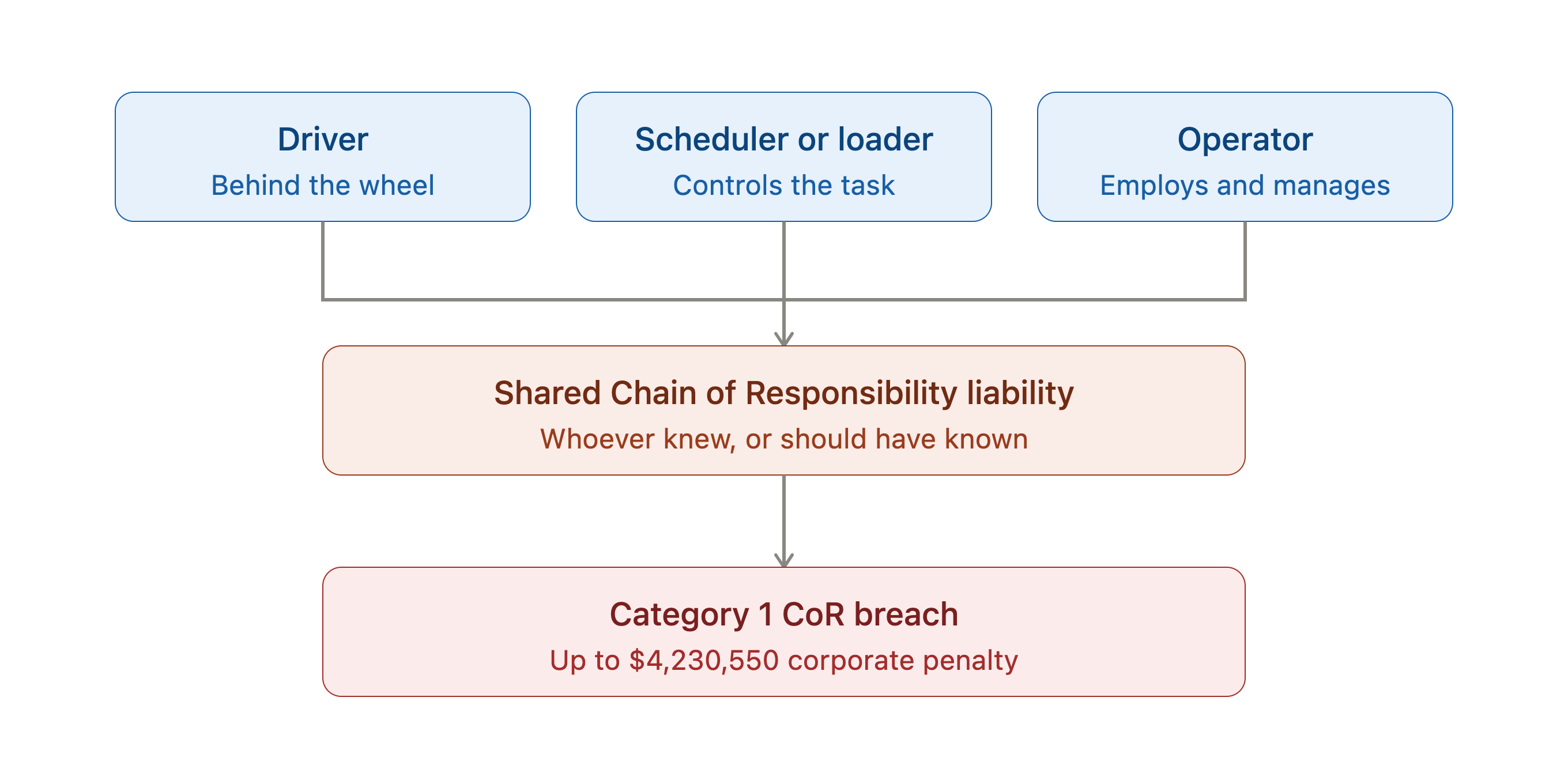
For commercial fleet operators, this distinction matters because of the Chain of Responsibility. Under the HVNL, the operator does not need to have been driving the vehicle to face charges. If the NHVR can demonstrate that the operator knew about unsafe driving behaviour (or should have known) and failed to take reasonable steps to prevent it, the operator faces CoR penalties.
The penalty exposure is significant. Category 1 CoR breaches under the HVNL (reckless conduct that exposes a person to a risk of death, serious injury, or serious illness) carry maximum penalties of $4,230,550 for a body corporate and $436,850 plus up to five years’ imprisonment for individuals (as of July 2026, CPI-indexed annually per NHVR guidance). In Victoria, dangerous driving in a heavy vehicle can attract up to 2 years’ imprisonment; culpable driving causing death can carry up to 10 years.
Driver Behaviours That Qualify as Reckless or Dangerous in a Fleet
These are the specific behaviours that telematics systems flag, that roadside inspectors look for, and that NHVR investigators target in CoR proceedings. Every one of these has been the basis of a fine, prosecution, or insurance claim against an Australian fleet operator.
Speeding. Any speed above the posted limit counts, but the penalties escalate sharply for heavy vehicles. In NSW, a heavy vehicle (over 4.5 tonnes GVM) caught 11 to 20 km/h over the limit faces a fine of $592 and 3 demerit points. At 31 to 45 km/h over, fines reach $1,774 for vehicles over 12 tonnes GVM with an automatic licence suspension of at least 3 months.
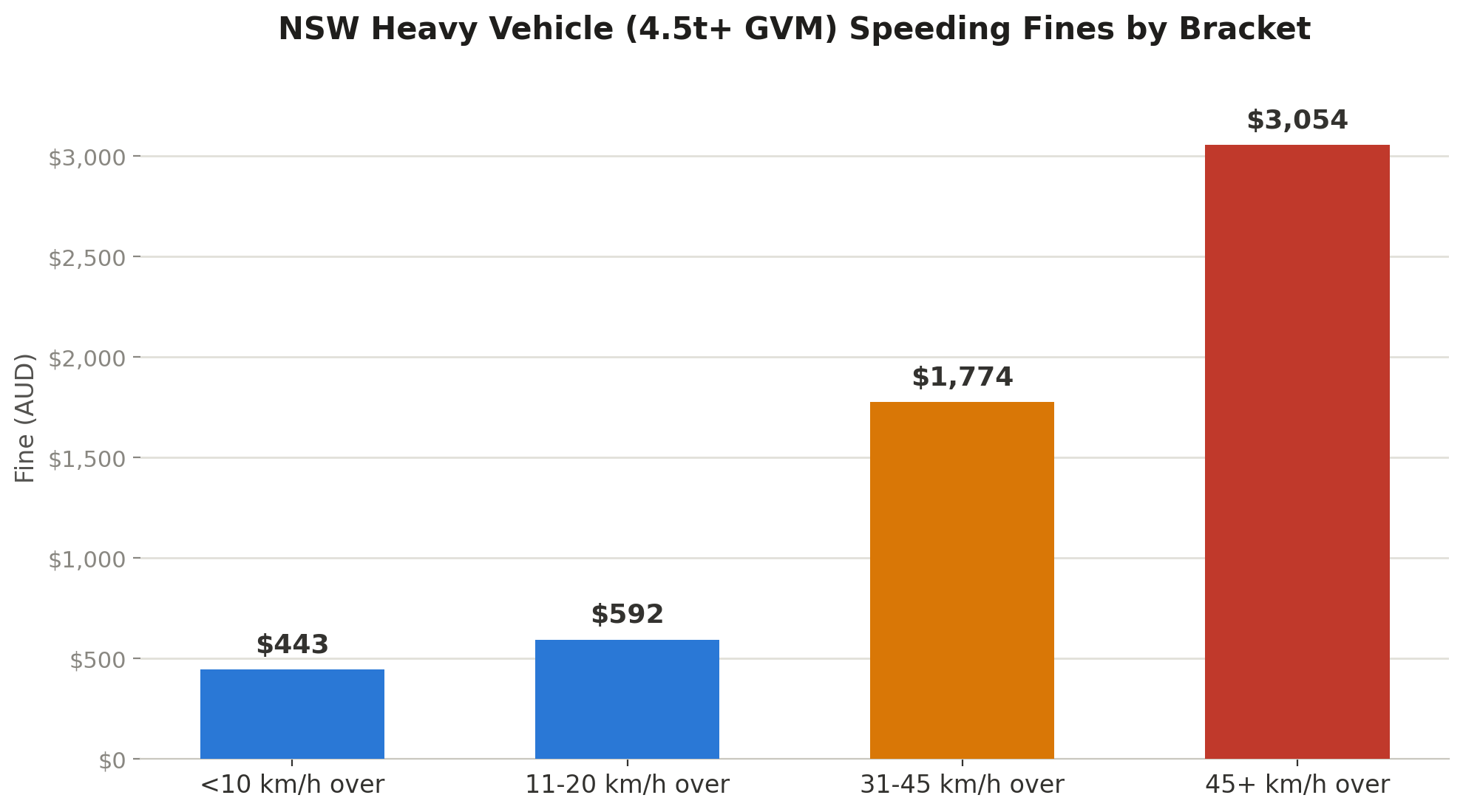
Victoria applies similar escalation: heavy vehicle speeding fines are listed separately and are higher than standard vehicle fines at every bracket (fine amounts correct as of 1 July 2026). A driver who loses their licence loses the ability to work. An operator who knew the driver was regularly speeding and did nothing faces CoR exposure.
Harsh braking. A telematics system typically flags harsh braking when the vehicle decelerates faster than a set G-force threshold, commonly 0.25g to 0.30g sustained for at least one second. Isolated harsh braking events happen to every driver. A pattern of harsh braking on most shifts indicates a driver who follows too closely, reacts late, or drives without anticipation. In a loaded heavy vehicle, harsh braking increases stopping distances, risks load shift, and puts significant stress on brake components and tyres, accelerating wear on both.
Aggressive cornering. For heavy vehicles, this is one of the highest-risk behaviours because of rollover exposure. Rollover is the most common fatal crash type for heavy vehicles. A telematics threshold of 0.4g or above in lateral acceleration for at least two seconds is a common trigger for a harsh cornering event. A B-double with a high centre of gravity taking a roundabout at 15 km/h over the advisory speed is not a driving-style preference. It is a rollover risk.
Mobile phone use while driving. In NSW, using a mobile phone while driving carries a fine of $423 and 5 demerit points (10 demerit points during double-demerit periods), current as of mid-2026. AI-equipped dashcams can detect phone use in real time and alert the driver before an incident. Without a dashcam, the operator typically only finds out about phone use when there is a crash, and the phone records are subpoenaed.
Driving while fatigued or unfit. Under the expanded Section 228(1) of the HVNL (commenced 1 August 2026), drivers of all heavy vehicles over 4.5 tonnes must not drive while impaired by fatigue or otherwise unfit to drive. “Unfit” now covers fatigue, illness, injury, mental health, medication effects, alcohol, and drugs. The fatigue duty penalty rose from $8,000 to $26,610 under the 2026 amendments (NHVR-confirmed). The new unfit-to-drive penalty is also $26,610. Operators have a corresponding duty not to cause or permit a driver to drive while unfit. This is not a theoretical risk. The NHVR recorded approximately 5,000 fatigue offences in 2025 and launched Operation Ambit in March 2026 specifically targeting fatigue and work diary breaches.
Driving with known vehicle defects. Sending a vehicle on the road with a known defect (failed brakes, defective steering, bald tyres, non-functional lights) is a vehicle standards offence under the HVNL and a direct CoR exposure. The NHVR issued 23 prohibition notices in FY2025-26, and in July 2026 imposed combined fines of $100,000 against a transport company and its director for breaching prohibition notices. This was the first use of court-injunction powers under the HVNL.
Seatbelt non-compliance. Victoria imposes a $418 fine and 3 demerit points for not wearing a seatbelt (as of 1 July 2026). AI dashcams detect seatbelt non-compliance automatically.
Driver Behaviour Monitoring Checklist for Fleet Operators
This is the practical checklist. Each item maps to a specific data source that your fleet management or telematics platform should capture, store, and make available for reporting.
Speed compliance
Monitor every trip against posted speed limits using GPS data. Set configurable thresholds (e.g. alert at 5 km/h over, escalate at 10 km/h over, critical alert at 20 km/h over). Log every speeding event with timestamp, GPS location, speed, posted limit, duration, and driver ID. Generate weekly speed compliance reports per driver. Review speed events in school zones and construction zones as high-priority.
Harsh braking events
Set a G-force threshold appropriate to your vehicle type (heavier vehicles need a lower threshold than light commercials). Log events with timestamp, location, speed at trigger, and driver ID. Track pattern frequency per driver per week. A driver logging harsh braking events on most shifts has a pattern, not a one-off. Escalate patterns to direct coaching within 48 hours.
Harsh acceleration
Track rapid acceleration events. Aggressive throttle from a stop increases fuel consumption noticeably and puts strain on drivetrain components. Use the same event-logging structure as braking: timestamp, location, speed delta, driver. This is often the behaviour drivers are least aware of.
Cornering and lateral G-force
Set lateral acceleration thresholds. For heavy vehicles, anything above 0.3g to 0.4g sustained for two seconds warrants review. Cornering events near roundabouts, highway off-ramps, and tight site entries are the highest-risk locations. Cross-reference cornering events with load status if your system tracks it. A loaded truck cornering aggressively is far more dangerous than an empty one.
Phone use and distraction
Deploy AI-equipped dashcams that detect phone handling, eating, smoking, and other distracting behaviours in real time. In-cab audio alerts give drivers an immediate warning. Log distraction events for coaching. Without a camera, phone use is effectively unmonitored until it causes an incident.
Fatigue and alertness
Use fatigue and distraction detection technology (FDDT). AI dashcams that monitor eye closure, head position, and yawning provide real-time alerts when a driver shows signs of fatigue. Cross-reference with Electronic Work Diary (EWD) or Written Work Diary data to verify compliance with work and rest hours under Standard Hours, BFM, or the new Alternative Compliance Hours (ACH) option from 1 August 2026. A driver who is compliant on paper but showing fatigue indicators on camera is still a risk.
We helped one Western Australian operator investigate after a truck equipped with FDDT technology logged 465 camera misalignment events over just six weeks. Drivers had been repositioning the camera to avoid detection. The truck later rolled and caught fire, killing one person. That case became an NHVR reference point for why FDDT technology only works if it is actively managed, not just installed.
Seatbelt compliance
AI dashcams detect whether the driver is wearing a seatbelt. Log non-compliance. This is one of the simplest behaviours to fix and one of the most consequential in a crash.
Idle time
Track excessive engine idling. Extended idling adds unnecessary fuel cost across a fleet. More importantly for this context, a driver idling in a loading bay for 45 minutes may be sleeping, not waiting for a load. Cross-reference idle events with fatigue
data.
Geofence and route compliance
Set geofence boundaries around approved routes, depots, client sites, and restricted zones. Alert on deviations. Unauthorised route changes may indicate personal use, unauthorised stops, or avoidance of weigh bridges.
Driver scorecards
Aggregate all the above into a per-driver scorecard updated weekly. Rank drivers on a composite safety score. Use the scorecard as the basis for structured coaching, not punitive action. Research consistently shows that driver awareness of monitoring improves behaviour. Fleets that implement scorecards with coaching see measurable reductions in harsh events within 90 days.
Why Monitoring Is a Legal Obligation, Not a Management Choice
Under the HVNL Chain of Responsibility provisions, the operator’s primary duty is to ensure, so far as reasonably practicable, the safety of transport activities. “Reasonably practicable” is assessed against what was known or ought to have been known at the time.
If telematics data showing repeated speeding, harsh braking, or cornering events existed in your system but nobody reviewed it, you knew or ought to have known. If you had no telematics system at all, a court or the NHVR will ask why not, given that monitoring technology is widely available and affordable.
The 2026 HVNL amendments reinforce this. Safety Management System (SMS) audit findings are now admissible as court evidence for CoR breach proceedings. If your SMS includes a driver behaviour monitoring policy, and the data shows you did not follow your own policy, that evidence works against you.
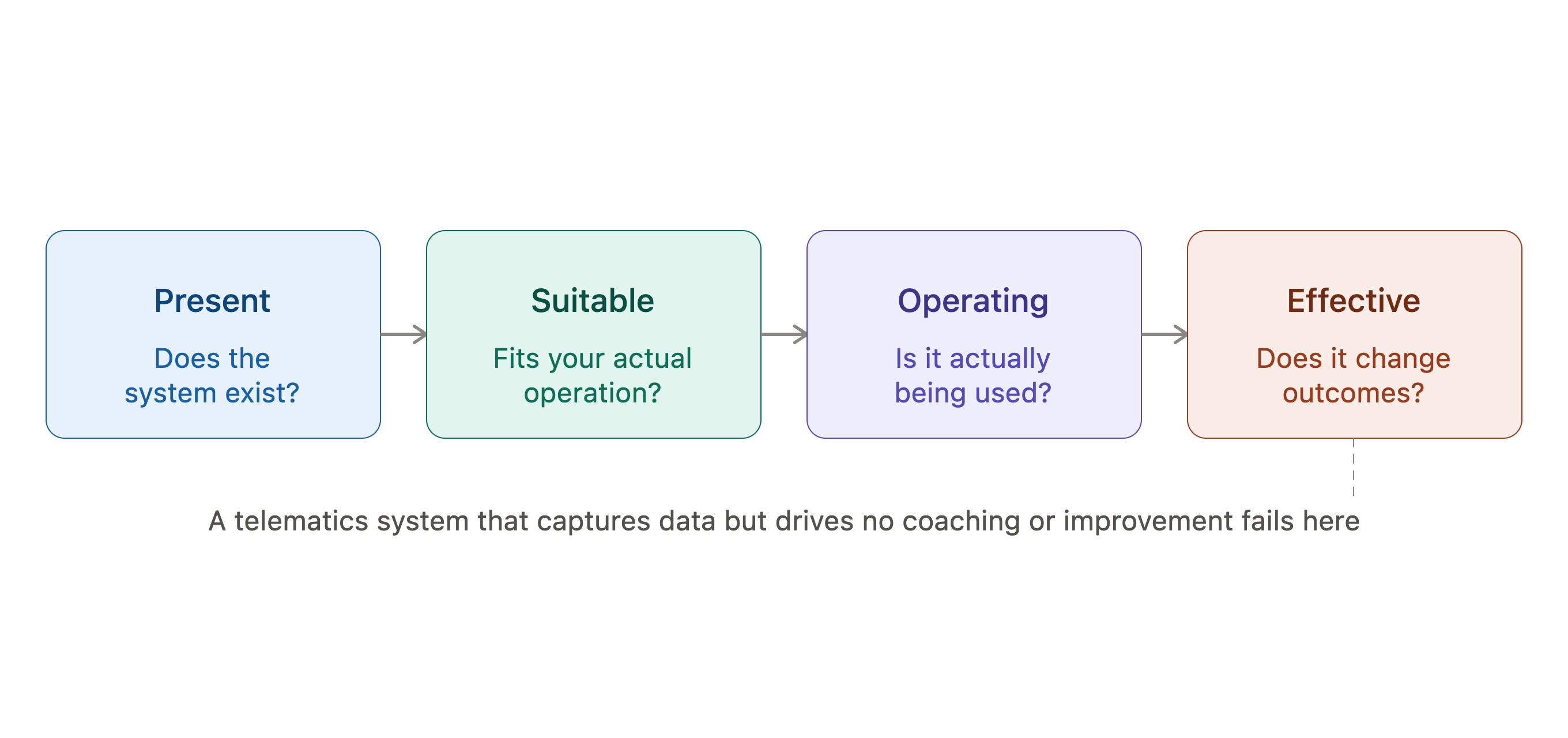
The NHVR’s PSOE audit framework (Present, Suitable, Operating, Effective) tests exactly this. Is your monitoring system Present? Is it Suitable for your operation? Is it Operating (are people actually using it)? Is it Effective (does it produce the safety outcomes it is designed to produce)? A telematics system that captures data but generates no coaching, no intervention, and no improvement will fail the Effective test.
Common Mistakes Operators Make with Driver Monitoring
Installing cameras or telematics and never reviewing the data. We see this constantly. The hardware is fitted. The dashboard has a login. Nobody opens it. When an incident happens, the data is there, but so is six months of ignored alerts that show the operator knew about the problem and did nothing. That is worse than not having the system at all.
Using monitoring as punishment instead of coaching. Drivers who feel surveilled without support disengage or, as in the WA case above, actively defeat the monitoring. A coaching-first approach, where the scorecard drives a structured conversation rather than a disciplinary outcome, produces better safety results and avoids the industrial relations problems that come with a purely punitive system.
Not setting thresholds appropriate to the vehicle type. A harsh braking threshold set for a 2-tonne delivery van will fire hundreds of false positives on a 42-tonne B-double. Conversely, a threshold set for a heavy vehicle will miss genuinely dangerous braking events on a light commercial. Configure thresholds per vehicle class.
Ignoring the privacy compliance layer. NSW passed the Digital Work Systems Act on 12 February 2026, which places a positive duty on employers to risk-assess the psychosocial impact of digital monitoring, including vehicle tracking and dashcams. Victoria’s Surveillance Devices Act 1999 was amended in December 2025. Since June 2025, Australia has a statutory tort for serious invasions of privacy. You must notify drivers clearly about what data you collect, how you use it, and who has access. Covert monitoring without notice can expose the operator to privacy claims that have nothing to do with road safety.
Frequently Asked Questions (FAQs)
What is considered reckless driving in a commercial fleet?
Reckless driving in a commercial fleet includes speeding at any margin above the posted limit, harsh braking and acceleration, aggressive cornering, mobile phone use, driving while fatigued or unfit to drive, driving with known vehicle defects, and seatbelt non-compliance. Under the HVNL, the operator shares liability with the driver if they knew or should have known about unsafe driving behaviour and failed to act.
What are the penalties for dangerous driving in a heavy vehicle in Australia?
Heavy vehicle speeding fines in NSW range from $443 for less than 10 km/h over the limit to $3,054+ for 45 km/h or more over. Victoria applies separate heavy vehicle speeding schedules at higher rates than standard vehicles. Dangerous driving can carry up to 2 years imprisonment. Culpable driving causing death carries up to 10 years in Victoria. HVNL Category 1 CoR penalties reach $4,230,550 for corporations and $436,850 plus up to 5 years imprisonment for individuals (as of July 2026).
How do telematics systems detect reckless driving?
Telematics systems use GPS data, accelerometers, and OBD/CAN bus integration to detect speeding, harsh braking, harsh acceleration, and aggressive cornering. AI-equipped dashcams add detection of phone use, fatigue indicators (eye closure, yawning, head drop), seatbelt non-compliance, and forward collision risk. Events are timestamped, GPS-located, and attributed to the driver on shift.
Is driver behaviour monitoring legally required for Australian fleet operators?
The HVNL does not mandate a specific monitoring technology. It mandates a primary duty to ensure safety so far as reasonably practicable. Given that telematics and dashcam technology is widely available and affordable, the NHVR and courts increasingly expect operators to demonstrate active monitoring. The 2026 HVNL amendments make SMS audit findings admissible as court evidence, which means your monitoring records (or the absence of them) can be used in CoR proceedings.
What G-force thresholds should I set for harsh braking and cornering?
Common industry thresholds are 0.25g to 0.30g deceleration sustained for one second for harsh braking, and 0.35g to 0.40g lateral acceleration sustained for two seconds for harsh cornering. These should be configured per vehicle class. A loaded B-double needs lower thresholds than an unloaded rigid truck. Set thresholds in consultation with your telematics provider and review quarterly based on event frequency and incident data.
Can I use dashcam footage as evidence in a CoR investigation?
Yes. Dashcam footage is admissible as evidence in Australian legal proceedings, including NHVR CoR investigations. It can work for or against you. Footage that shows a driver using a phone before a crash supports the investigation. Footage that shows 465 camera misalignment events over six weeks demonstrates that monitoring was installed but not managed. The evidence value of dashcam data depends entirely on whether the operator reviewed it and acted on what it showed.
Do I need to tell drivers they are being monitored?
Yes. Under state surveillance and privacy legislation (including Victoria’s Surveillance Devices Act 1999, the NSW Digital Work Systems Act 2026, and the federal statutory tort for serious invasions of privacy effective June 2025), operators must provide clear notice about what monitoring data is collected, how it is used, and who has access. Covert monitoring without notice can expose the operator to privacy claims. Best practice is a written monitoring policy signed by each driver as part of induction.