

Preventative vs reactive fleet maintenance is a measurable cost difference, not a philosophical debate. Reactive repairs typically cost several times more per event than the same work done on schedule, and for a 10-truck Australian fleet the gap between the two approaches runs into tens of thousands of dollars a year — before counting the NHVR compliance risk reactive maintenance creates.
Preventative vs reactive fleet maintenance is not a philosophical debate. It is a measurable cost difference. Industry data consistently shows unplanned reactive repairs cost several times more per event than the same work done on a preventive schedule. For an Australian heavy vehicle operator running 10 to 20 trucks, that gap compounds into tens of thousands of dollars per year in avoidable repair bills, downtime, and NHVR defect notices. The operators who keep vehicles on the road and pass audits without drama are the ones who schedule maintenance before something breaks.
What Preventative Fleet Maintenance Actually Involves
Preventative maintenance means servicing vehicles on a structured schedule before components fail. That schedule is based on manufacturer intervals, odometer readings, engine hours, or calendar dates, whichever triggers first. For a typical heavy vehicle fleet, this covers oil and filter changes, brake inspections, tyre rotations, fluid checks, cooling system flushes, and air system tests.
The key distinction is timing. You are replacing brake pads at 80{a1ecdeac7aa669694223042b5414f4ebc99bf67e8f4841ec62bf1bd690e4433f} wear, not after the driver reports metal-on-metal noise on the Pacific Highway. You are checking air system pressure at every scheduled service, not after an NHVR roadside inspector issues a defect notice because the compressor takes too long to build pressure.
Under the Heavy Vehicle National Law (HVNL), operators must ensure vehicles are maintained in a roadworthy condition at all times. The law does not prescribe a specific maintenance schedule, but it creates a legal expectation: if a defect would have been apparent under a reasonable maintenance inspection program, the NHVR will hold you accountable for not having one. That “reasonable” standard is where preventative maintenance becomes a legal requirement, not just a preference.
Daily pre-start inspections are part of this picture. Under HVNL Chapter 4, drivers must not drive a heavy vehicle unless it is safe to operate. A pre-start walk-around covering tyres, brakes, lights, mirrors, steering, fluids, and coupling (for combinations) is the expected minimum. When that inspection finds a defect, the defect-to-repair loop needs to be documented and closed. A driver who reports worn brake pads on Tuesday morning needs evidence that the pads were replaced before the truck went back on the road, not a verbal assurance from the workshop that it will get done this week.
What Reactive Fleet Maintenance Costs You
Reactive maintenance means fixing things after they break. Some operators run this way deliberately, reasoning that they save money by not servicing vehicles that seem fine. Others run this way accidentally because their maintenance tracking is a whiteboard, a spreadsheet, or the workshop supervisor’s memory.
The direct repair cost difference is significant. A planned preventative service on a heavy vehicle typically runs $400 to $800 AUD depending on the service tier. An emergency repair for the same component failure can average $3,200 or more, because you are paying after-hours labour rates, emergency parts sourcing, and towing fees if the truck is stranded. Industry benchmarks show unplanned downtime costs between $448 and $760 per vehicle per day when you include lost revenue, reallocation of loads, and driver idle time.
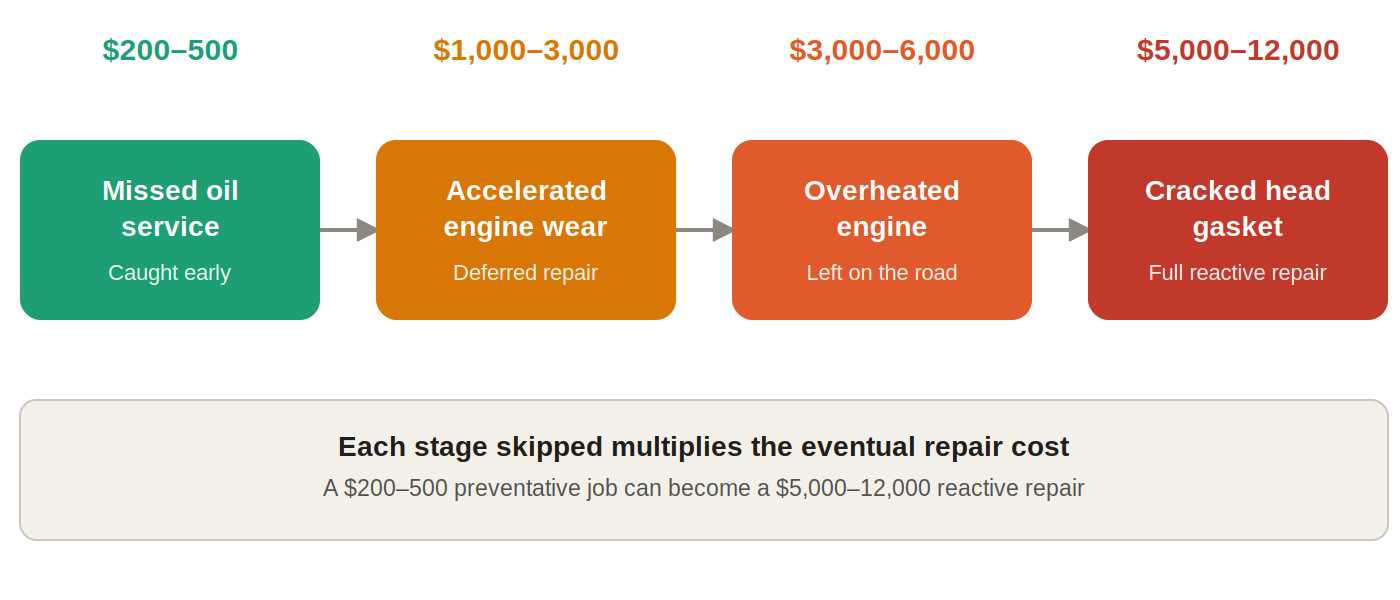
But the biggest cost multiplier in reactive maintenance is cascade damage. A missed oil service leads to accelerated engine wear. A deferred brake inspection means worn pads that damage rotors. A skipped coolant flush turns into an overheated engine and a cracked head gasket. Each of these scenarios can turn a $200 to $500 preventative job into a $5,000 to $12,000 reactive repair.
The numbers compound quickly across a fleet. The U.S. Department of Energy’s Federal Energy Management Program has found preventive maintenance delivers an estimated 12 to 18 percent cost savings over reactive approaches — a widely-cited figure originally from industrial/facility maintenance research, though commonly and reasonably applied to fleet contexts as well. For a 15-truck fleet spending $180,000 per year on total maintenance, a saving in that range translates to roughly $21,600 to $32,400 in annual savings by scheduling work before failures occur.
Insider observation: The cost gap we see most often in Australia is not the big-ticket engine failure. It is the compounding effect of deferred tyre management. An operator who skips regular tyre rotation and pressure checks on a B-double ends up replacing tyres well before their expected service life, and often throws in a set of damaged wheel bearings from running underinflated for months. Over a year across five combinations, that adds up to more than the operator spent on the tyres themselves.
NHVR Compliance Risks of Reactive Maintenance
For Australian heavy vehicle operators, the cost of reactive maintenance goes beyond repair bills. The NHVR enforces strict roadworthiness standards, and a vehicle maintained reactively is far more likely to attract defect notices, infringements, and in serious cases, vehicle grounding.
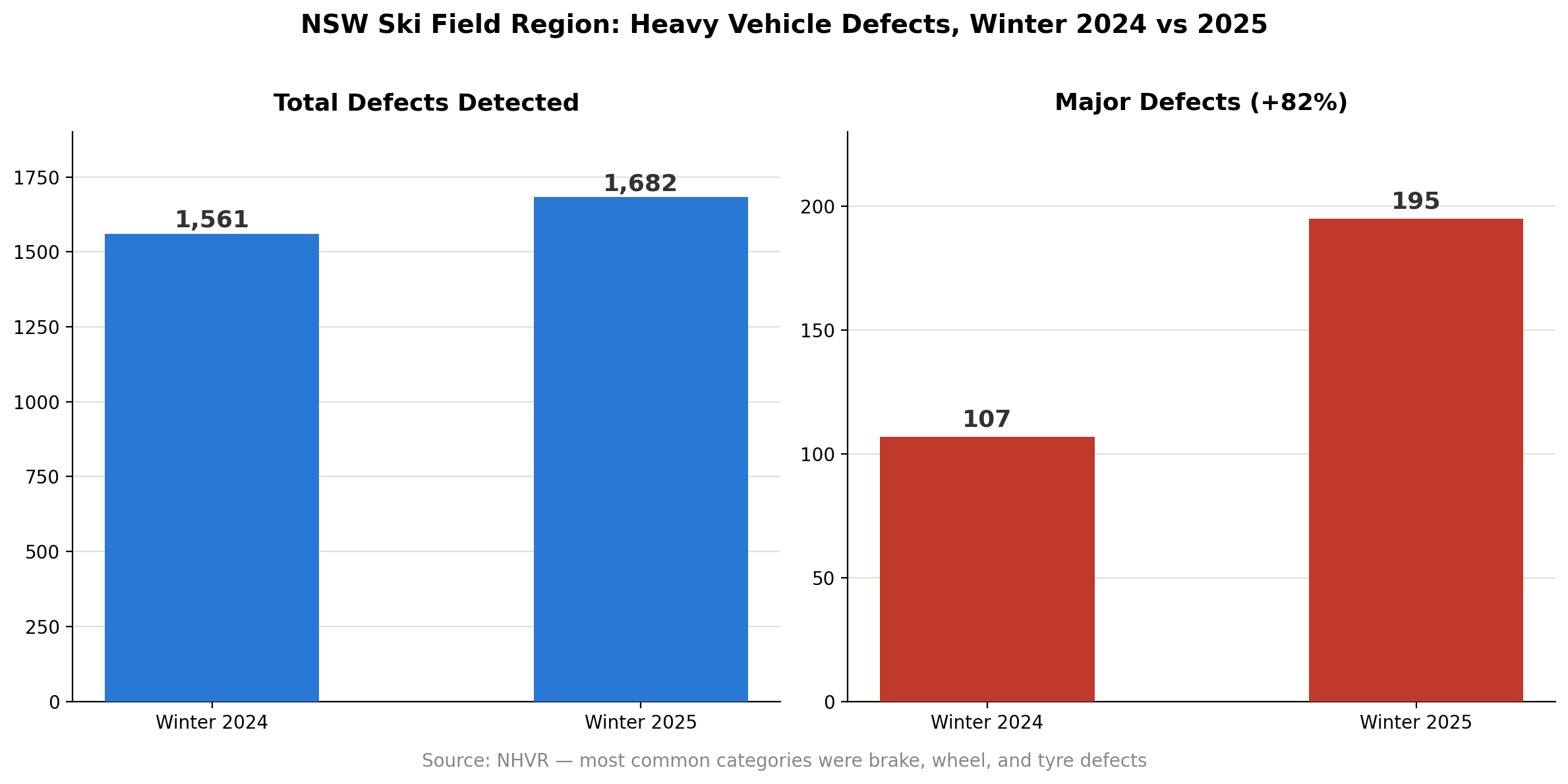
NHVR data from the NSW snow regions illustrates the pattern clearly. Between winter 2024 and winter 2025, the number of individual defects detected on heavy vehicles in the NSW ski field region rose from 1,561 to 1,682. Major defects increased by approximately 82 percent, from 107 to 195. The most common categories were brake, wheel, and tyre defects — exactly the components a basic preventative schedule catches. Year-to-date data for 2026 suggests the trend is continuing, with 650 individual defects detected in June 2026 alone.
A major defect notice grounds the vehicle until repairs are completed and an authorised officer or approved inspection station clears it. That means the truck sits wherever the defect was found. If that is a roadside inspection point 300 km from your workshop, you are paying towing plus a mobile mechanic at emergency rates, plus the cost of the load sitting on a grounded truck, plus a replacement vehicle to finish the delivery. For operators with NHVAS Maintenance Management accreditation (now transitioning to the new Heavy Vehicle Accreditation scheme from 1 August 2026), a pattern of defect notices can trigger an out-of-cycle audit or accreditation review.
Insider observation: We have seen operators lose NHVAS Maintenance accreditation because they could not produce defect rectification records. The vehicle was repaired, the mechanic did the work, but nobody documented it. When the auditor asked for evidence that a reported defect was fixed before the vehicle went back on the road, the operator pointed at the truck and said “it’s fixed, look at it.” That does not pass PSOE (Present, Suitable, Operating, Effective). The system was not present on paper, so it failed at the first hurdle. A digital maintenance system that timestamps the defect report, the work order, and the sign-off closes this gap automatically.
The Real Cost Comparison: Preventative vs Reactive
Here is what the numbers look like side by side for a 10-vehicle heavy vehicle fleet in Australia.
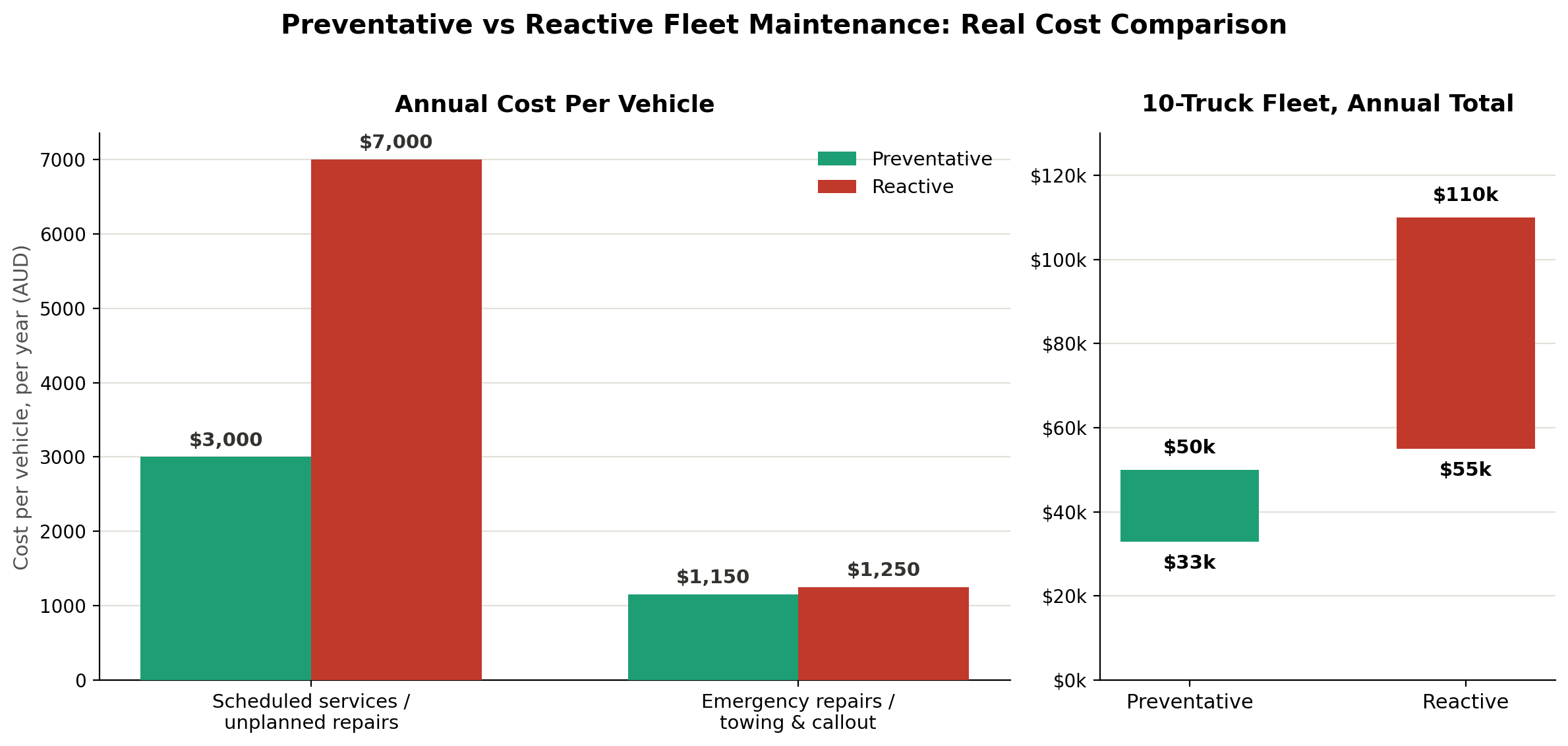
Preventative maintenance approach (annual per vehicle):
Scheduled services and inspections: $2,500 to $3,500. Unplanned repairs (still occur, but reduced): $800 to $1,500. Downtime days per year: 3 to 5. Defect notices per year: rare if schedule is followed.
Reactive maintenance approach (annual per vehicle):
Emergency and breakdown repairs: $5,000 to $9,000. Towing and roadside callout fees: $500 to $2,000. Downtime days per year: 10 to 20. Defect notices per year: 2 to 4 per vehicle is common for poorly maintained fleets.
For a 10-truck fleet, the reactive approach costs roughly $55,000 to $110,000 per year in direct repair and towing costs alone. The preventative approach runs $33,000 to $50,000 for the same fleet. That difference of $20,000 to $60,000 per year does not include the indirect costs: lost revenue from grounded trucks, penalty rates for late deliveries, higher insurance premiums, and the time your operations manager spends on the phone arranging emergency repairs instead of managing the business.
A frequently cited industry estimate holds that a large majority of fleet breakdowns come from failures that were preventable through scheduled maintenance — the specific percentage varies across sources, but the direction of the finding is consistent: most breakdowns aren’t random.
How the August 2026 HVNL Changes Affect Maintenance
The Heavy Vehicle National Law Amendment Act 2025 commenced on 1 August 2026 with no grace period. Several changes directly affect how operators manage maintenance.
Safety Management Systems are now mandatory for accredited operators. The old NHVAS Maintenance Management module is being replaced by the Heavy Vehicle Accreditation (HVA) scheme. Under HVA, accreditation is whole-of-business, not module-by-module. Your maintenance practices are audited as part of your overall Safety Management System, alongside fatigue, mass, and general safety. An SMS audit that finds maintenance records are missing, incomplete, or inconsistent will count against your accreditation and can be used as evidence in a CoR prosecution.
The PSOE audit standard applies. Auditors now assess whether your maintenance system is Present (documented), Suitable (appropriate for your operation), Operating (actually being followed), and Effective (producing real outcomes). A maintenance schedule printed and laminated on the workshop wall but not reflected in actual service records will fail at “Operating.”
CoR penalties post-July 2026 CPI indexation are substantial. Category 1 reckless conduct offences carry maximum penalties of $4,230,550 for a body corporate and $436,850 plus up to 5 years imprisonment for individuals. Even a Category 3 breach reaches $705,820 corporate and $70,580 individual. An operator who knowingly sends an unroadworthy vehicle onto the road because they chose not to schedule a brake service is squarely in CoR territory.
The expanded “unfit to drive” duty covers vehicle condition. Under expanded Section 228(1), drivers of all heavy vehicles over 4.5 tonnes GVM must be fit to drive. While this duty primarily targets fatigue and impairment, an operator who directs a driver to take out a vehicle with known unresolved defects is creating a situation where the driver cannot safely operate the vehicle. The line between a driver fitness issue and a vehicle fitness issue blurs fast when an auditor looks at the maintenance records.
Common Mistakes Operators Make with Fleet Maintenance
1. Running a “fix it when it breaks” workshop without realising the compliance exposure. Reactive maintenance is not just expensive. Under the HVNL, it creates a documented trail of non-compliance if a defect that caused an incident was one that a reasonable maintenance schedule would have caught.
2. Scheduling by calendar only, not by usage. A truck doing Sydney to Melbourne runs five days a week needs more frequent servicing than one doing local metro deliveries. Scheduling every vehicle for the same 10,000 km service regardless of duty cycle means some trucks are over-serviced (wasting money) and others are under-serviced (creating risk). Service triggers based on odometer readings, engine hours, or telematics data produce a schedule that matches actual wear.
3. No closed-loop defect management. A driver reports a defect on Monday. The workshop fixes it on Wednesday. Nobody records the fix. On Thursday an NHVR inspector or auditor asks for the defect rectification record and the operator cannot produce one. The vehicle may be perfectly safe, but the system failure is what gets penalised.
Insider observation: The worst version of this we see regularly is the operator who uses a paper pre-start checklist but files completed forms in a box that nobody reads. The drivers are doing the daily check. They are reporting defects. But because nobody reviews the forms until the box gets full, defects go unactioned for weeks. A digital pre-start system that triggers an automatic alert to the workshop when a defect is reported closes the loop on the same day. That is the difference between a system that exists on paper and a system that actually operates.
4. Not adjusting manufacturer intervals for operating conditions. A light commercial vehicle rated for 15,000 km oil changes running in dusty outback conditions, constant stop-start urban traffic, or towing heavy loads needs shorter intervals. Ignoring operating environment is one of the most common causes of premature component failure in Australian fleets.
5. Treating maintenance and compliance as separate functions. Your maintenance records are compliance evidence. Your compliance obligations define your minimum maintenance standard. Operators who manage maintenance in one system and compliance in another (or in no system at all) create gaps that NHVR auditors find quickly.
How to Shift from Reactive to Preventative Maintenance
The transition does not happen overnight, but the first steps are practical.
Audit your current state. Pull your repair records from the last 12 months. Categorise each job as planned or unplanned. If more than 30 percent of your maintenance spend is unplanned, you are running a reactive operation. Industry benchmarks suggest fleets on a structured preventative program keep unplanned work below 15 to 20 percent.
Set up tiered service schedules. Most heavy vehicle fleets use an A/B/C structure: a minor service (A) every 10,000 to 15,000 km, a mid-level service (B) every 30,000 to 40,000 km, and a major service (C) every 80,000 to 100,000 km. Adjust based on manufacturer guidance, duty cycle, and operating conditions.
Digitise your pre-start and defect reporting. Paper forms create lag between defect identification and repair action. A digital system that timestamps the report and sends it directly to the workshop eliminates that lag. This is not optional for operators seeking HVA accreditation; the PSOE standard requires evidence that the system is operating in practice, not just on paper.
Track the shift. Measure your planned-to-unplanned maintenance ratio monthly. Track mean time between failures (MTBF) per vehicle. Monitor defect notice frequency. These numbers will tell you whether your program is working and give you evidence for your next accreditation audit.
Structured preventative maintenance programs consistently return their cost many times over in avoided reactive expenses. For operators running fleets in Australia under the HVNL, it also returns something harder to price: a compliant maintenance record that holds up under NHVR scrutiny.
FAQ
How much more does reactive fleet maintenance cost than preventative?
Industry research consistently shows reactive repairs cost several times more per event than the same work done on a preventative schedule. For Australian heavy vehicle operators, unplanned downtime adds $448 to $760 per vehicle per day on top of the repair cost. A 10-truck fleet running reactively typically spends $20,000 to $60,000 more per year than one on a structured preventative program.
Is preventative maintenance a legal requirement under the HVNL?
The HVNL does not prescribe a specific maintenance schedule. However, it requires that heavy vehicles be maintained in a roadworthy condition at all times and that operators have systems in place to manage vehicle safety. If a defect would have been apparent under a reasonable maintenance inspection program, the NHVR will hold the operator accountable. In practice, this means documented preventative maintenance is the baseline expectation, not a nice-to-have.
What happens if my truck gets a major defect notice from the NHVR?
A major defect notice grounds the vehicle immediately. It cannot be moved until repairs are completed and an authorised officer or approved inspection station clears it. If the vehicle is on the road when the defect is found, you are paying towing, emergency repair costs, and lost revenue while it sits grounded. Repeated defect notices can trigger an out-of-cycle accreditation review under the new HVA scheme.
How does the 2026 HVNL accreditation change affect maintenance?
From 1 August 2026, the old NHVAS Maintenance Management module is being replaced by the Heavy Vehicle Accreditation (HVA) scheme. Under HVA, maintenance is audited as part of a whole-of-business Safety Management System, not as a standalone module. Auditors use the PSOE standard: your maintenance system must be Present, Suitable, Operating, and Effective. Existing NHVAS accreditations remain valid until they expire, and the transition is phased.
What maintenance records do I need to keep for an NHVR audit?
At minimum: completed daily pre-start inspection records, scheduled service records with dates and odometer readings, defect reports with corresponding rectification records (showing what was found, what was done, and when the vehicle was cleared for use), parts and consumables records, and evidence that unsafe vehicles were taken off the road until defects were fixed. Under the new HVA scheme, these records must demonstrate that the system is genuinely operating, not just that the paperwork exists.
Can I lose my accreditation for poor maintenance records?
Yes. Under both NHVAS and the incoming HVA scheme, an operator who cannot produce evidence that their maintenance system is operating effectively can have accreditation suspended or revoked. SMS audit findings are now admissible as court evidence in CoR breach proceedings under the amended HVNL, which means a failed maintenance audit can lead to both accreditation loss and prosecution.
What is the best ratio of planned to unplanned maintenance?
Industry benchmarks for well-run fleets target 80 to 85 percent planned maintenance and 15 to 20 percent unplanned. Fleets without a digital maintenance system typically run 40 to 55 percent reactive work. If your ratio is worse than 70/30 planned-to-unplanned, your program needs attention.