

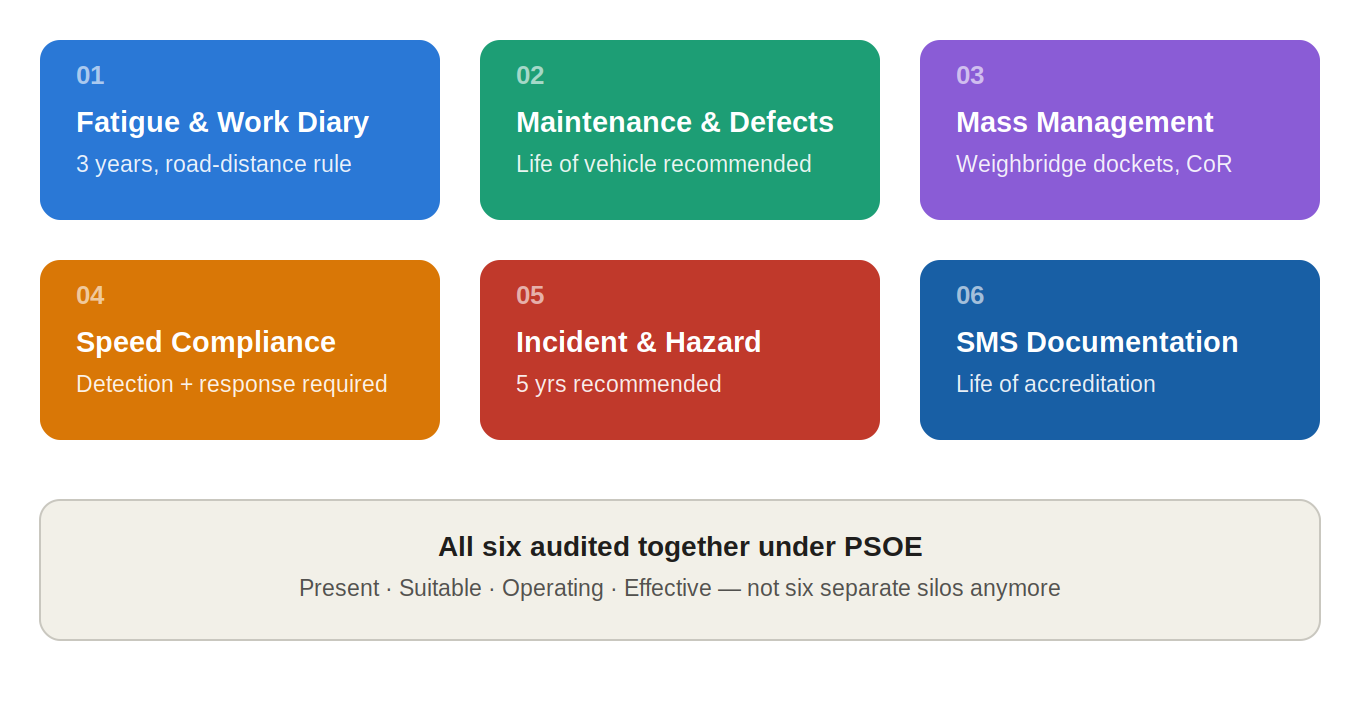
Australian heavy vehicle operators must maintain at least six categories of compliance reports under the Heavy Vehicle National Law (HVNL): fatigue and work diary records, maintenance and defect logs, mass management dockets, speed compliance data, incident and hazard reports, and Safety Management System (SMS) documentation. All records must be retained for a minimum of three years and produced on request to an authorised officer. Since 1 August 2026, operators with Heavy Vehicle Accreditation (HVA) must also demonstrate their reporting systems are not just present but operating and effective under the new PSOE audit standard.
Most operators we onboard know they need to keep records. The problem is almost never “we don’t have any paperwork.” It is that the records sit in five different places, nobody has checked whether they are actually complete, and the first time anyone tries to pull them together is the morning an auditor walks in.
That is exactly the scenario the 2026 HVNL reforms were designed to address. The shift from the old NHVAS module-based system to a whole-of-business SMS assessment means auditors no longer check fatigue, mass, and maintenance in separate silos. They assess your entire reporting system as one connected operation, and they score it against four maturity levels: Present, Suitable, Operating, and Effective (PSOE).
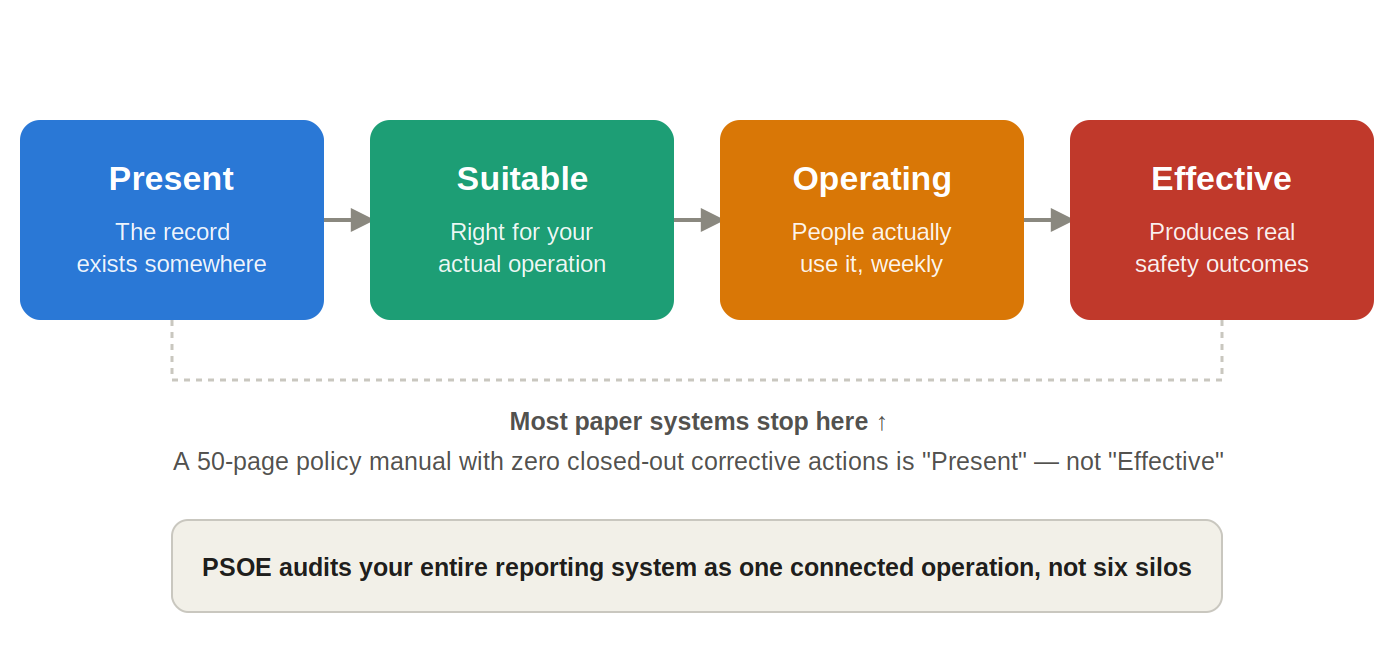
If your fleet reporting only clears “Present” (the documents exist somewhere in a folder), you will not pass a 2026 HVA audit. We have seen operators with 50-page policy manuals fail because they could not show a single corrective action that was actually closed out. Paper-based systems can technically satisfy “Present,” but that is the only PSOE element they reliably clear.
Here is every report category you need, what each one must contain, and the retention rules that apply.
Fatigue Management and Work Diary Records
Fatigue reporting is where NHVR enforcement activity is highest. The regulator recorded approximately 5,000 fatigue offences in 2025, and Operation Ambit, launched in March 2026, specifically targets fatigue and work diary breaches.
Every driver of a fatigue-regulated heavy vehicle who drives more than 100 km from their nominated base must record work and rest hours in a work diary. That diary can be a National Driver Work Diary (paper, duplicate-page system) or an NHVR-approved Electronic Work Diary (EWD).
What must be recorded:
The start and finish time of every work period and rest period, the vehicle registration number, the odometer reading at the start and end of each trip, the driver’s nominated base, and any changes to the selected fatigue rule set (Standard Hours, Basic Fatigue Management, or Advanced Fatigue Management).
Retention:
Both the original and duplicate pages must be kept for three years from the date of creation. They must be stored at the driver’s nominated record location and produced on request to an authorised officer. NHVR guidance recommends duplicate pages be submitted to the record keeper promptly after completion, though the HVNL wording requires submission “as soon as practicable.”
Insider note:
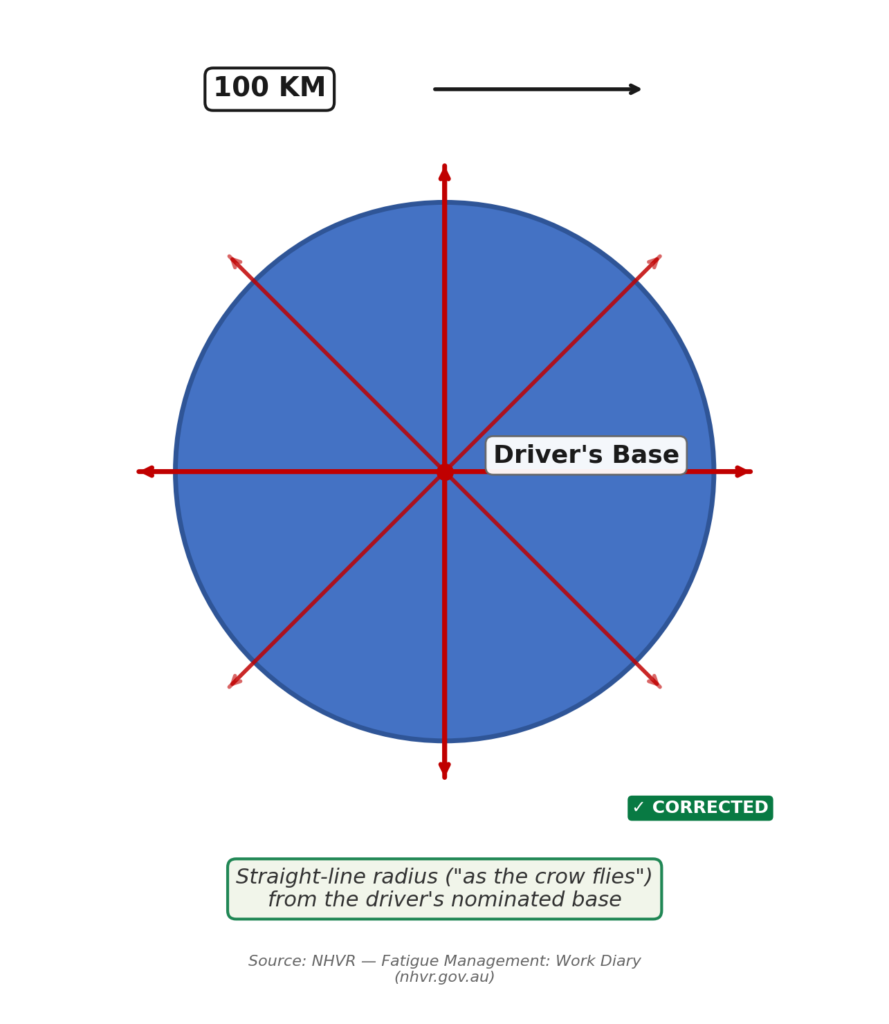
Correction (September 2026): An earlier version of this article stated the 100 km work diary threshold was measured by road distance. This was incorrect. The 100 km radius is measured as a straight-line distance (“as the crow flies”) from the driver’s nominated base, not by the actual road distance driven. This means a driver who travels 120 km by road but remains within 100 km of their base in a straight line is still within the exemption and does not need to keep a work diary (though local area records must still be maintained). Conversely, a driver whose straight-line distance from base exceeds 100 km must keep a work diary even if they took a shorter road route. If your drivers regularly operate near that boundary, confirm the straight-line distance, not the odometer reading. (Source: NHVR – Fatigue Management: Work Diary)
The penalty for an employer or operator who fails to ensure driver fatigue compliance rose significantly under the 2026 reforms, from $8,000 to $26,610 per offence (as of 1 August 2026, NHVR-confirmed).
Maintenance and Defect Reports
Every vehicle in your fleet needs a documented maintenance history that covers scheduled servicing, unscheduled repairs, and driver-reported defects. Under the HVNL, vehicle owners and operators have a duty to ensure every heavy vehicle used on a road complies with the heavy vehicle standards that apply to it.
What must be recorded:
Scheduled service records tied to manufacturer intervals (typically every 10,000 to 20,000 km depending on vehicle type), pre-trip inspection results (daily, completed by the driver before each shift), defect reports and the date, time, and nature of rectification, and component replacement records.
Retention:
Maintenance and defect records must be kept for a minimum of three years. Best practice, and what we recommend to every operator regardless of fleet size, is to retain these records for the life of the vehicle. In the event of a catastrophic failure, litigation, or a coronial inquiry, records older than three years may be requested and their absence will be noted.
Insider note: The defect-to-rectification loop is where small operators most often trip up. A driver reports a cracked mudguard on a pre-trip check. The mechanic fixes it. But nobody records the fix against the original defect entry, so the audit trail shows an open defect with no closure. Under PSOE, that is a failure at “Operating” because the system exists but is not being followed consistently. If you run fewer than 20 trucks, assign one person to close out defect reports weekly. It takes 30 minutes and it is the difference between a clean audit and a non-conformance.
Mass Management Dockets
Mass and loading compliance is a core Chain of Responsibility (CoR) obligation. Every party in the transport chain, from the consignor to the loader to the operator, shares legal responsibility for ensuring a vehicle is not overloaded.
What must be recorded:
Weighbridge docket data (date, time, location, gross mass, axle group masses), container weight declarations (verified gross mass for containerised freight), on-board mass system readings (if fitted), and records of any load adjustments made before departure.
Retention:
Three years minimum. If your operation is accredited under the new HVA scheme for Alternative Compliance Accreditation (ACA) for mass, your audit will specifically examine whether mass records are not just present but suitable for your operation’s risk profile. A general freight operator running B-doubles needs a more detailed mass reporting system than a sole operator with two rigid trucks.
Queensland has historically recorded high volumes of mass limit infringements relative to other HVNL jurisdictions.
Speed Compliance Records
Speed management is a CoR obligation. Operators must demonstrate they are not directing, pressuring, or incentivising drivers to exceed speed limits.
What must be recorded:
GPS/telematics speed data, any speed-related alerts or exceptions generated by your fleet management system, records of any investigation or follow-up action taken after a speed event, and evidence that scheduling and route planning does not require drivers to exceed speed limits to meet delivery windows.
Retention:
Three years, consistent with general HVNL record-keeping requirements. The important detail here is that the records need to show a response, not just a detection. Having 200 speed alerts in your system with no follow-up action recorded against any of them is worse than having no system at all, because it shows you were aware of the issue and did nothing. That is the exact pattern NHVR investigators look for in a CoR investigation.
Incident and Hazard Reports
Under both the HVNL and state workplace health and safety (WHS) laws, operators must report and investigate safety incidents. Since 1 August 2026, the expanded “unfit to drive” provisions under HVNL Section 228(1) mean incident reporting now covers a broader range of events than it previously did.
What must be recorded:
The date, time, and location of the incident, the people involved, a description of what happened, the immediate response taken, the root cause investigation findings, and the corrective actions implemented. For notifiable incidents under WHS legislation (death, serious injury, or dangerous incident), there are separate reporting obligations to the relevant state WHS regulator (SafeWork NSW, WorkSafe Victoria, Workplace Health and Safety Queensland, etc.).
Near-miss and hazard reports are equally critical. Under the PSOE framework, auditors look for evidence that your SMS captures near-misses and uses them to identify systemic risks before they produce an actual incident.
Retention:
Three years minimum for HVNL-related records. WHS regulators in some jurisdictions require longer retention for notifiable incidents. Our standard advice: default to five years for anything incident-related. Storage is cheap. Defending a prosecution without records is not.
Safety Management System (SMS) Documentation
This is the newest and most significant reporting category. From 1 August 2026, every accredited heavy vehicle operator must maintain a documented SMS. The SMS Standard 2026 requires five components, and auditors assess each one using the PSOE method under the National Audit Standard.
What must be recorded:
Your risk register (identifying foreseeable hazards across all transport activities), documented policies and procedures for fatigue, fitness to drive, mass, maintenance, speed, and CoR, training records for all relevant personnel, internal audit findings and corrective actions, management review minutes showing safety decisions and their outcomes, and evidence of continuous improvement.
The 2026 Master Code of Practice, released by the NHVR in January 2026, identifies 45 transport activities, over 70 hazards, and more than 500 recommended controls. While the Master Code is not legally mandatory, courts may reference it as a benchmark for what constitutes “reasonably practicable steps.” If you have not reviewed it against your own risk register, do that now.
Insider note: The most common SMS documentation failure we see is a complete absence of management review records. An operator will have policies, procedures, even a decent risk register. But there is no evidence that anyone in management has ever sat down, reviewed the data coming out of the system, and made a decision based on it. Under PSOE, that is a failure at “Effective.” The system exists, it is suitable, it is even operating day to day, but it is not producing outcomes that management acts on. Schedule a quarterly review. Record what was discussed, what was decided, and who is responsible for follow-through. Even 30 minutes with notes is enough.
Record Retention Summary
| Report Category | Minimum Retention | Recommended Retention | Primary Source |
| Fatigue / work diary records | 3 years from creation | 3 years (statutory) | HVNL, NHVR record keeping guidance |
| Maintenance and defect logs | 3 years | Life of vehicle | NHVR maintenance management standards |
| Mass management dockets | 3 years | 5 years | HVNL mass/dimension provisions |
| Speed compliance records | 3 years | 5 years | HVNL CoR provisions |
| Incident and hazard reports | 3 years (HVNL), 5 years (some state WHS) | 5 years | HVNL + state WHS legislation |
| SMS documentation | 3 years | Life of accreditation | SMS Standard 2026, National Audit Standard |
Retention periods verified against NHVR record keeping guidance and HVNL provisions as of August 2026.
Common Reporting Mistakes That Trigger Audit Non-Conformances
Storing records across disconnected systems. Fatigue data in one app, maintenance in a spreadsheet, mass dockets in a filing cabinet, incident reports in email. When an auditor asks to see the complete compliance picture for a single vehicle over the last 12 months, you need to produce it within a reasonable time. “I’ll have to check three systems and get back to you” is not a good answer during an audit.
Keeping records without acting on them. This is the trap that catches experienced operators. You have the telematics data, the speed alerts, the defect reports. But the records show no evidence of investigation, follow-up, or corrective action. Under PSOE, a system that generates data nobody acts on fails at “Operating.” The auditor’s question is not “do you collect this data?” It is “show me what you did with it.”
Confusing record-keeping with compliance. Having a folder of completed pre-trip inspection forms does not prove your vehicles were maintained. It proves drivers filled in forms. If the same defect appears on three consecutive pre-trip reports with no rectification record, the forms themselves become evidence of a systemic failure. Records must connect: defect reported, defect assessed, repair completed, vehicle cleared for service.
Failing to update records when regulations change. The 2026 HVNL reforms changed penalty categories, expanded the unfit-to-drive duty, and introduced new SMS requirements. If your reporting templates still reference the old NHVAS module structure or the pre-2026 fatigue penalty amounts, your documentation is not suitable for your current regulatory environment. That is a failure at PSOE “Suitable.”
How Automated NHVR Fleet Reporting Reduces Audit Risk
The gap between what regulators expect and what most 10-to-50 truck operators can realistically maintain with manual systems has grown significantly since 1 August 2026. A whole-of-business SMS audit that scores across PSOE requires connected data, not isolated spreadsheets.
Manage Vehicle’s compliance management platform consolidates fatigue records, maintenance logs, mass dockets, incident reports, and driver documentation into a single system. When an auditor asks for the compliance history of vehicle #27 over the last 18 months, you can produce it in minutes, not days.
Automated daily and weekly fleet reporting means defect-to-rectification loops close with a digital trail. Speed events generate alerts that require a recorded response. Pre-trip inspections sync directly to maintenance workflows. The system produces the connected, auditable evidence chain that PSOE requires at the “Operating” and “Effective” levels.
For operators transitioning from NHVAS to HVA, our document management and reporting tools provide the structured record-keeping framework that maps directly to the SMS Standard 2026 requirements.
FAQ
What reports does the NHVR require fleet operators to keep?
The NHVR requires operators to maintain fatigue and work diary records, vehicle maintenance and defect logs, mass management dockets, speed compliance data, incident and hazard reports, and (for accredited operators) Safety Management System documentation. All must be retained for a minimum of three years and produced on request.
How long must fleet compliance records be kept in Australia?
The HVNL mandates a minimum three-year retention period for most compliance records from the date of creation. Records must be stored in a readable format and reasonably assumed to remain readable for at least three years. Some state WHS jurisdictions require longer retention for notifiable incidents.
What happens if I cannot produce records during an NHVR audit?
Failure to produce required records on request to an authorised officer is an offence under the HVNL. Beyond the infringement penalty (set at 10{a1ecdeac7aa669694223042b5414f4ebc99bf67e8f4841ec62bf1bd690e4433f} of the maximum court-imposable penalty for the relevant offence), the inability to demonstrate compliance through records will result in audit non-conformances under the PSOE method. Repeated non-conformances can lead to accreditation suspension or cancellation.
Do I need an Electronic Work Diary (EWD) or are paper logbooks still acceptable?
Paper National Driver Work Diaries remain legal as of August 2026. The NHVR has not mandated EWDs. The practical reality is that EWDs produce minute-by-minute records that eliminate the rounding errors common in paper diaries and provide real-time breach alerts. For any operator running more than five trucks, the audit advantages of EWDs over paper are substantial.
What is the PSOE audit method and how does it affect my reporting?
PSOE stands for Present, Suitable, Operating, and Effective. It is the audit methodology used under the new Heavy Vehicle Accreditation (HVA) scheme from 1 August 2026. Auditors assess your entire Safety Management System against these four maturity levels. Your reporting must show not just that records exist (Present) but that they are appropriate for your operation (Suitable), consistently followed in daily work (Operating), and producing measurable safety improvements (Effective).
What are the penalties for CoR reporting failures?
Penalties depend on the category of breach. As of 1 August 2026, maximum court-imposed penalties for CoR breaches are: Category 1 (reckless conduct) up to $4,230,550 for corporations and $436,850 plus up to five years imprisonment for individuals; Category 2 up to $2,120,880 for corporations; Category 3 up to $705,820 for corporations. Infringement notice penalties are set at 10{a1ecdeac7aa669694223042b5414f4ebc99bf67e8f4841ec62bf1bd690e4433f} of these maximums. These figures reflect July 2026 CPI indexation.
Does the HVNL apply in Western Australia and Northern Territory?
No. The HVNL applies in NSW, VIC, QLD, SA, TAS, and ACT. Western Australia and the Northern Territory operate under their own heavy vehicle legislation. Operators running interstate routes that include WA or NT must comply with dual regulatory frameworks.