
Real time GPS tracking vs passive GPS tracking is the first decision any Australian fleet operator needs to get right before choosing a provider. Real time GPS tracking transmits vehicle location and telemetry data continuously over cellular or satellite networks, giving fleet managers live visibility. Passive GPS tracking, by contrast, stores data on the device and uploads it only when the vehicle returns to a depot or connects to a download point. For any Australian fleet running heavy vehicles under the HVNL, real time tracking is the only option that supports live fatigue monitoring, geofence alerts, and the kind of audit-ready records the NHVR now expects.
How Real Time GPS Tracking vs Passive GPS Tracking: How They Actually Work
The difference between real time GPS tracking vs passive GPS tracking is not about accuracy. Both use the same satellite constellation to calculate position. The difference is what happens to that position data after it’s captured.
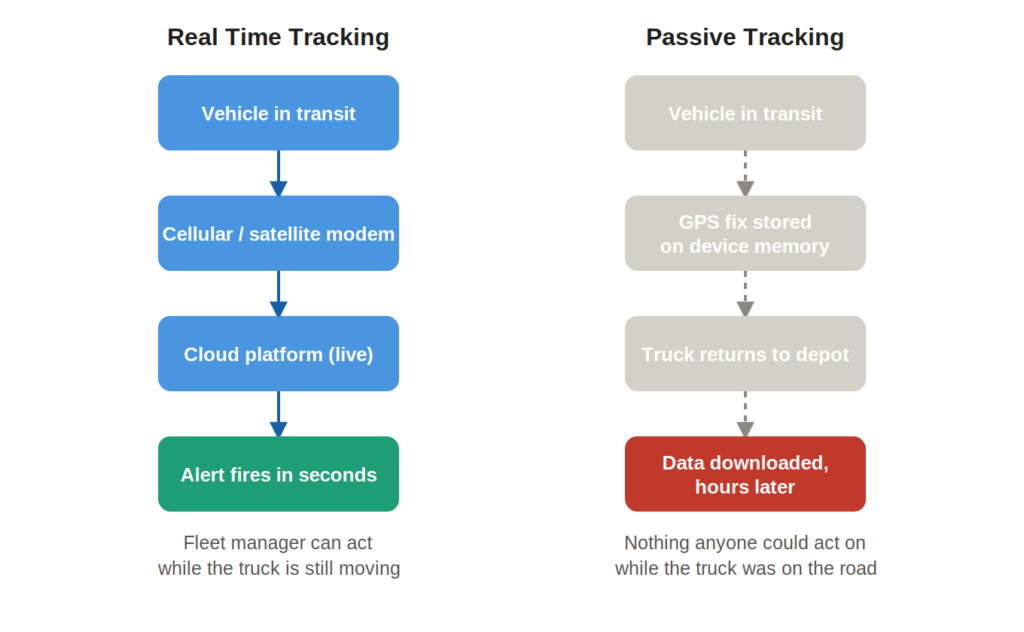
A real time (also called “active”) GPS tracker has an onboard cellular or satellite modem. It transmits location, speed, heading, and sensor data to a cloud platform at intervals anywhere from every 5 seconds to every few minutes, depending on configuration. The fleet manager sees a live map. Alerts fire immediately when a vehicle enters or leaves a geofence, exceeds a speed threshold, or triggers harsh braking.
A passive tracker has no modem or keeps it dormant. It logs GPS fixes to internal memory and holds them until the vehicle physically comes back within range of a Wi-Fi hotspot or a docking station at the depot. The fleet manager gets the data hours or days later. Some operators still refer to this as “download-and-review” tracking.
Most modern commercial fleet trackers sold in Australia are real time units running on 4G LTE Cat-1. Passive-only devices are increasingly rare in the heavy vehicle sector and are more commonly found in personal asset tracking or in very small fleets tracking a ute or two for mileage logs.
Why the Distinction Matters for Australian Fleet Compliance
This is where the Australian regulatory context separates this decision from a generic cost comparison.
Under the Heavy Vehicle National Law (HVNL), which commenced its major amendment on 1 August 2026, Chain of Responsibility (CoR) parties carry a primary duty to ensure the safety of their transport activities. That duty is now assessed using the PSOE framework: auditors look at whether your safety controls are Present, Suitable, Operating, and Effective. A tracking system that only uploads data when a truck returns to the yard cannot demonstrate that it was “operating” in real time during the journey. It can show historical data, but it cannot show that anyone was monitoring it or able to intervene.
We see this gap come up in almost every CoR audit where the operator has older tracking hardware. The auditor asks: “How did you know where this vehicle was at 2am on Tuesday the 14th?” If the answer is “we downloaded the data on Friday,” that is not evidence of active risk management. It is a record. Records matter, but the 2026 Master Code of Practice (released by the NHVR in January 2026, covering 45 transport activities and 500+ recommended controls) makes it clear that operators should have real time monitoring capabilities as part of their Safety Management System (SMS).
The NHVR recorded nearly 5,000 fatigue offences in 2025. Operation Ambit, launched in March 2026, specifically targets fatigue and work diary breaches. Fatigue penalties rose sharply under the amended HVNL: the duty-of-driver-to-avoid-driving-while-fatigued penalty jumped from $8,000 to $26,610 (as of 1 July 2026 CPI indexation, confirmed by the NHVR). A new “unfit to drive” penalty, also $26,610, now covers fatigue, illness, medication effects, and mental health impacts for all heavy vehicles over 4.5 tonnes GVM. For CoR parties at the corporate level, Category 1 (reckless conduct) penalties reach $4,230,550.
A passive tracker cannot alert you to a breach before it happens. A real time system integrated with an Electronic Work Diary (EWD) can flag a driver approaching their work limit and give the scheduler time to act.
Real Time GPS Tracking: What It Does and What It Costs
Real time tracking for a commercial fleet vehicle in Australia typically involves a hardwired 4G unit (hardwired to vehicle power, not battery) plus a monthly subscription for data, platform access, and support.
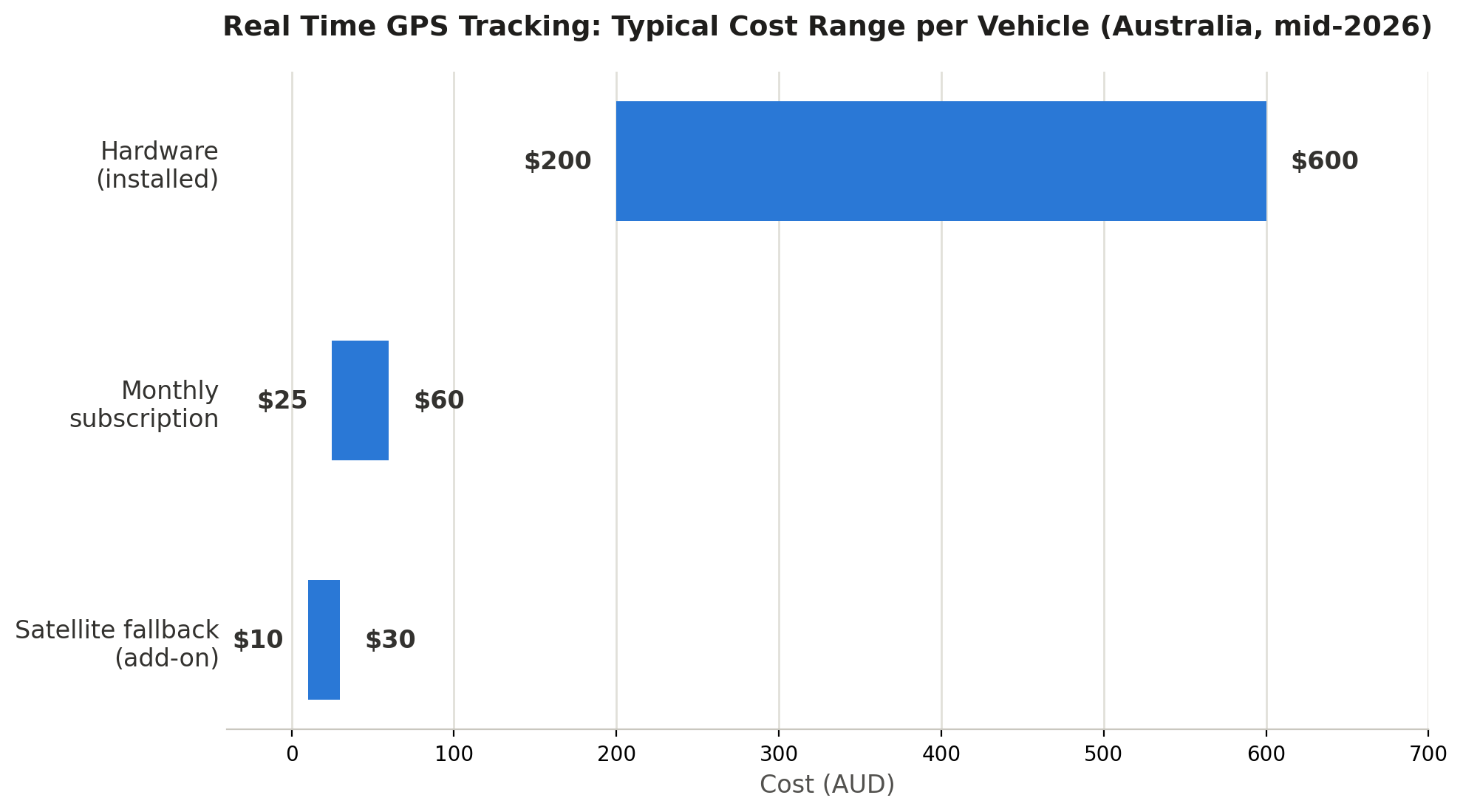
Typical cost ranges for Australian fleets (as of mid-2026):
| Component | Typical Range |
| Hardware (per vehicle, installed) | $200 – $600 depending on features and sensors |
| Monthly subscription (per vehicle) | $25 – $60 depending on platform tier |
| Satellite fallback add-on (Iridium) | $10 – $30/month additional where required |
These figures vary by provider and contract length. Some providers bundle hardware into the subscription, others sell it outright.
What you get for that cost, beyond a dot on a map:
Live location and speed, typically updating every 10-30 seconds. Geofence entry/exit alerts that fire within seconds. Harsh braking, acceleration, and cornering scoring. Engine diagnostics via CAN-bus or OBD port. Integration with EWD platforms for correlated fatigue data. Driver ID (iButton, RFID, or Bluetooth). Trip replay and historical reporting. Remote immobilisation capability (where legally appropriate).
One thing we notice operators often miss: real time does not mean “always transmitting.” Well-designed trackers use store-and-forward logic. When a vehicle passes through a cellular dead zone, the device logs GPS fixes locally and uploads the batch when signal returns. This is standard on any quality 4G fleet tracker and is not the same as passive tracking. Store-and-forward is a connectivity resilience feature. Passive tracking is a fundamentally different architecture where download only happens at the depot.
Passive GPS Tracking: Where It Still Has a Role
Passive trackers are cheaper upfront. A basic passive GPS logger can cost under $100, with no ongoing subscription because there is no data transmission. Battery-powered passive loggers can run for months without charging because they are not powering a modem.
For Australian fleet operators, passive tracking has a narrow but legitimate use case:
Tracking unpowered trailers, dollies, or containers that sit idle for weeks between movements and where real time visibility is not operationally needed. Mileage verification for Fringe Benefits Tax (FBT) calculations where the operator only needs total distance and route history, not live position. Short-term monitoring of a specific vehicle for internal investigation or performance review.
But for any vehicle operating under the HVNL, passive tracking on its own is not fit for purpose. It does not meet the standard an auditor will look for under the 2026 PSOE framework. It cannot feed live data to your EWD platform. It cannot trigger a geofence alert when a driver deviates from an approved route. It cannot support real time fatigue intervention.
We have had operators come to us after a CoR investigation where the regulator asked for evidence of what the operator knew about a vehicle’s movements during a specific incident window. A passive system can provide that data retroactively, but only after it has been downloaded, and only if the download was not corrupted, the device memory was not full, and nobody turned it off. Real time tracking provides a continuous, timestamped, cloud-stored record that exists independently of the driver or the device memory.
The Remote Australia Problem: Why Hybrid Matters
Australia is not the UK. A tracker that works on the M1 in Melbourne does not automatically work on the Tanami Track or the Barrier Highway west of Nyngan.
Telstra’s 4G network covers approximately 99{a1ecdeac7aa669694223042b5414f4ebc99bf67e8f4841ec62bf1bd690e4433f} of the Australian population, but population coverage is measured by residential addresses. Road corridor coverage, especially through inland NSW, central Queensland, the Pilbara, and the NT, has significant gaps. A 4G-only tracker goes silent through those stretches.
This is where hybrid real time tracking with satellite fallback becomes relevant. Units with dual-mode modems (4G primary, Iridium satellite secondary) automatically switch to satellite transmission when cellular signal drops. Iridium covers the entire planet, including every metre of outback highway. Satellite airtime costs have dropped substantially since 2024, making this option accessible to operators running 10-20 trucks, not just the big linehaul fleets.
For operators running metro-only or well-covered highway routes (Hume, Pacific, Bruce), a standard 4G real time tracker with store-and-forward is sufficient. For operators running into remote corridors, a hybrid 4G/satellite unit is the correct specification.
One mistake we see regularly: operators buy a 4G-only tracker, then complain about “system outages” when their trucks go silent through remote stretches. That is not an outage. That is a coverage limitation the hardware was never designed to handle. Worse, some operators are still running 3G hardware without realising it. Every Australian 3G network has now been shut down. If a tracker stopped reporting sometime in the past 18 months and nobody investigated, the 3G sunset is the most likely cause.
What to Look for When Choosing a Real Time GPS Tracker for Australian Fleets
Not all real time trackers are equivalent. For heavy vehicle operations under the HVNL, the following capabilities matter:
4G LTE Cat-1 or Cat-1bis as a minimum. No 3G. Confirm multi-carrier SIM support or at least Telstra as primary, since Telstra has the widest regional coverage in Australia.
Store-and-forward with sufficient onboard memory. A tracker that drops data when it loses signal is worse than useless. Ask the provider how many GPS fixes the device can store locally before it starts overwriting. For a truck crossing the Nullarbor, you need days of buffer, not hours.
NHVR-approved EWD integration. A tracking platform with fatigue monitoring features is not the same as an NHVR-approved EWD. The NHVR maintains a register of approved EWD systems. Your GPS tracking platform should integrate with an approved EWD, not substitute for one.
Geofencing with configurable alerts. Not just entry/exit. You need time-in-zone alerts (has the driver been stationary at a loading dock for over 3 hours?), corridor monitoring, and speed zone overlays.
CAN-bus or J1939 connectivity. Heavy vehicles transmit engine data on the J1939 protocol. A tracker that reads this data provides fuel consumption, engine hours, fault codes, and idle time alongside GPS position. This feeds directly into maintenance scheduling and fuel management.
Driver ID. If you do not know who was driving, your GPS data is incomplete for CoR purposes. iButton, RFID card, or Bluetooth phone pairing are the common methods.
Privacy Act and workplace surveillance compliance features. Under the Privacy Act 1988, GPS location data is personal information. In NSW, the Workplace Surveillance Act 2005 requires 14 days’ written notice to employees before tracking begins. In the ACT, the Workplace Privacy Act 2011 has similar notice requirements, with fines of $5,000 per offence for non-compliance. Since June 2025, a new statutory tort for serious invasion of privacy means covert location tracking can attract civil liability beyond the existing state-level penalties. Your platform should support configurable tracking windows (on-shift vs off-shift) and clear audit logs of consent and notification.
Common Mistakes Operators Make with Fleet GPS Tracking
Treating GPS tracking as a set-and-forget install. We onboard operators who had trackers fitted three years ago and have never logged into the platform since. The hardware works, but nobody is using the data. Under the PSOE framework, a control that is “present” but not “operating” or “effective” does not satisfy your CoR duty.
Assuming the tracker is an EWD. It is not, unless it appears on the NHVR’s approved EWD register. We have seen operators present GPS trip logs to auditors as if they were work diary records. The auditor will not accept them. GPS tracking and EWD are complementary systems, not interchangeable.
No written tracking policy for drivers. If you operate in NSW and have not given 14 days’ written notice, your tracking may be unlawful under the Workplace Surveillance Act regardless of how good your hardware is. In a dispute, the first thing a driver’s representative will ask for is the surveillance notice. If you do not have one, you have a problem that no GPS provider can solve.
Ignoring the data until something goes wrong. The value of real time tracking is in proactive intervention. If you only look at the data after an incident, you have an expensive passive system with a modem attached.
Frequently Asked Questions (FAQs)
Is real time GPS tracking a legal requirement for heavy vehicles in Australia?
No specific provision of the HVNL mandates GPS tracking. But the NHVR’s 2026 Master Code of Practice includes real time vehicle monitoring as a recommended control across multiple transport activities. Under the PSOE audit framework, operators who lack real time visibility will find it harder to demonstrate that their safety management systems are “operating” and “effective.” It is not legally required, but it is practically expected.
Can I use a passive GPS tracker and still pass an NHVR audit?
Passive tracking alone is unlikely to satisfy an auditor assessing your fatigue or speed management controls under the PSOE framework. Passive data shows what happened after the fact but does not demonstrate real time monitoring or intervention capability. If you run vehicles under Standard Hours or BFM/AFM accreditation, the auditor will want to see evidence of active oversight.
How much does real time GPS fleet tracking cost in Australia?
Hardware typically runs $200-$600 per vehicle installed. Monthly subscriptions range from $25-$60 per vehicle depending on platform features. Satellite fallback for remote operations adds $10-$30 per month. Some providers bundle hardware into longer-term contracts. These figures are indicative as of mid-2026.
Do I need satellite GPS tracking for my fleet?
If your vehicles operate exclusively in metro areas or on major highway corridors with consistent 4G coverage, a standard 4G tracker with store-and-forward is sufficient. If any of your routes pass through remote corridors (inland NSW, outback QLD, NT, Pilbara, Nullarbor), a hybrid unit with Iridium satellite fallback is the correct specification.
What workplace laws apply to GPS tracking of fleet vehicles in Australia?
At the federal level, the Privacy Act 1988 classifies GPS location data as personal information. State laws add specific requirements: NSW requires 14 days’ written notice under the Workplace Surveillance Act 2005. The ACT has similar provisions under the Workplace Privacy Act 2011, with $5,000 fines per offence. Victoria’s Surveillance Devices Act 1999 (amended December 2025) requires consent for tracking devices. Since June 2025, a new statutory tort for serious invasion of privacy applies federally. Operators running vehicles across state borders should apply the strictest applicable rule across their entire fleet.
What is the difference between GPS tracking and an Electronic Work Diary?
GPS tracking records vehicle location and movement. An EWD records driver work and rest hours for fatigue compliance. They serve different legal and operational purposes. An EWD must be specifically approved by the NHVR and listed on their approved register. A GPS platform with “fatigue features” does not qualify as an approved EWD unless it appears on that register.
Are 3G GPS trackers still working in Australia?
No. All Australian 3G networks have been shut down. Any GPS tracker that relied on 3G connectivity has stopped transmitting. If a fleet tracker stopped reporting in the past 18 months and the cause was never investigated, the 3G shutdown is the most likely explanation. The hardware needs to be replaced with a 4G or 4G/satellite unit.
Next step: If your fleet is running trackers you have not checked since they were installed, or if you are still relying on passive data downloads at the depot, start with a tracking audit. Check what hardware is actually fitted, confirm it is on 4G, verify it integrates with your EWD, and make sure someone is actually reviewing the live data. See how Manage Vehicle’s GPS fleet tracking integrates with compliance, fatigue, and maintenance management in a single platform.