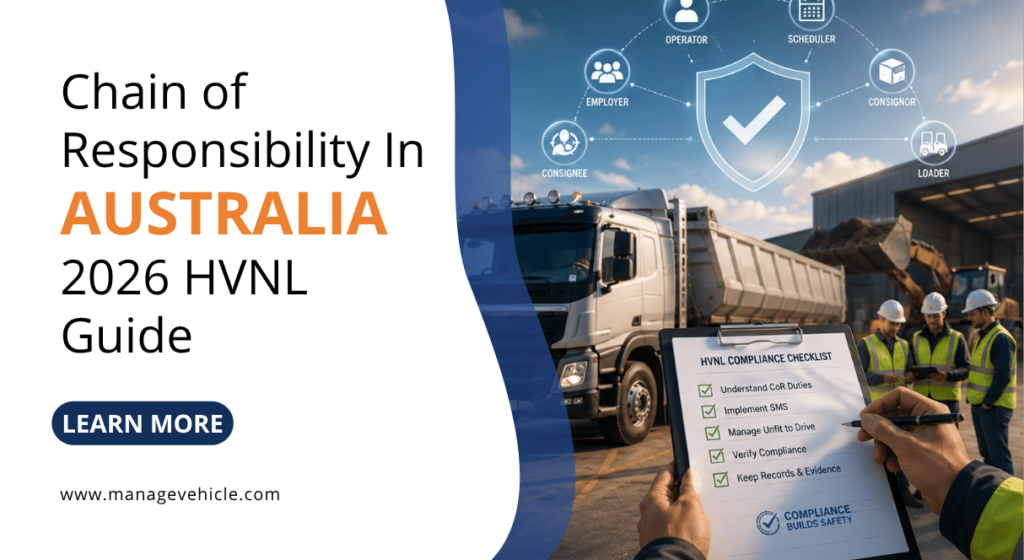
Chain of Responsibility (CoR) is the section of the Heavy Vehicle National Law (HVNL) that makes every party who controls or influences a heavy vehicle transport activity liable for safety. That includes operators, schedulers, consignors, consignees, loaders, and executives, not just drivers. On 1 August 2026, the amended HVNL commenced with no grace period, introducing mandatory Safety Management Systems for accredited operators, a broader “unfit to drive” duty, restructured penalties, and the 2026 Master Code of Practice. This guide covers who has CoR duties, what changed, what the penalties look like, and what practical steps operators should take.
Who Has CoR Duties Under the HVNL
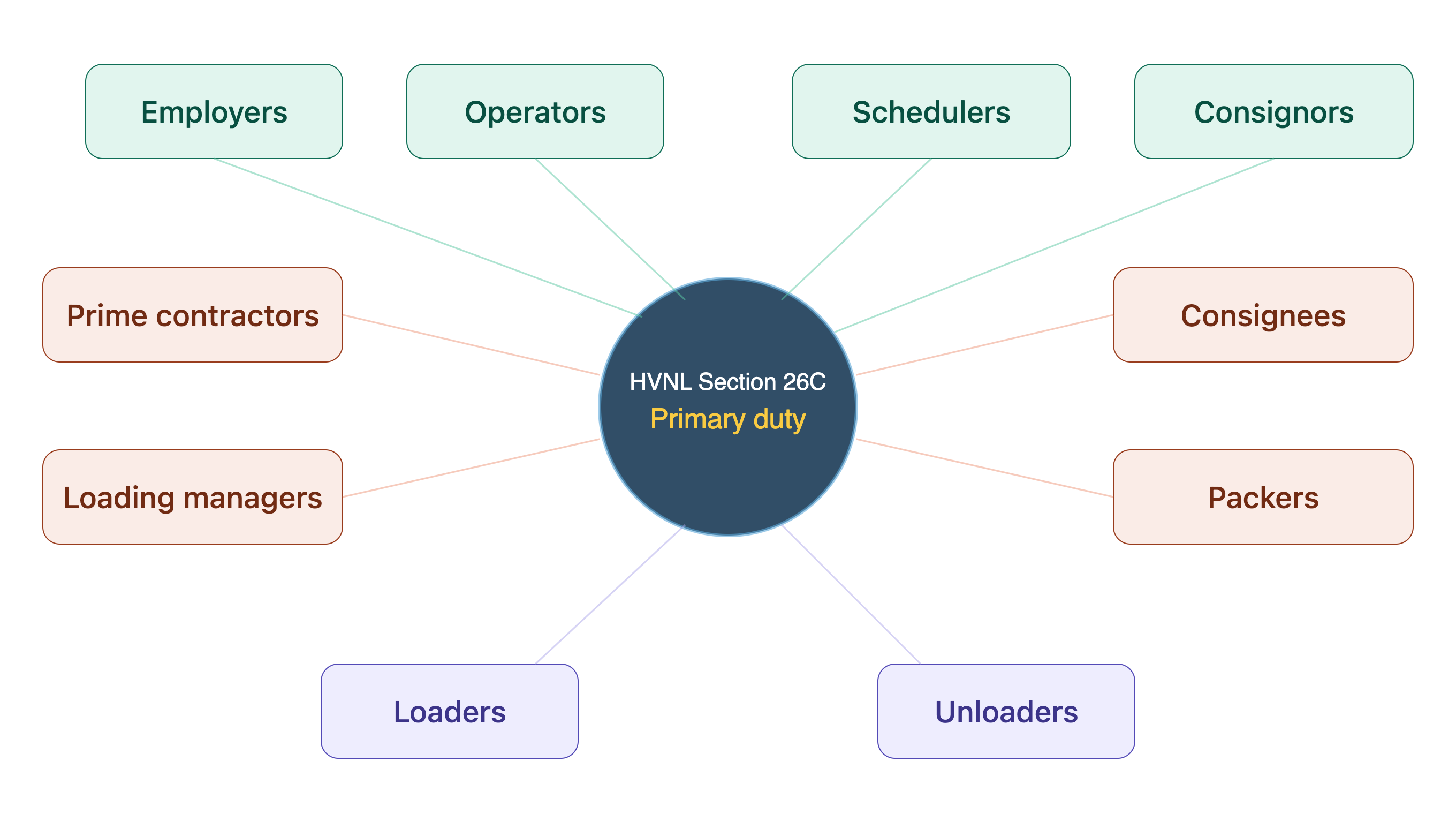
CoR is function-based. The HVNL does not assign liability by job title or contract wording. It assigns liability by function performed. The NHVR’s guidance on the primary duty identifies ten CoR party types: employers, prime contractors, operators, schedulers, consignors, consignees, packers, loading managers, loaders, and unloaders.
Each party shares the same obligation under HVNL Section 26C: ensure, so far as is reasonably practicable, the safety of their transport activities.
What that means operationally: a warehouse that schedules a pickup knowing the driver has been working since the previous day is performing a scheduler function. A quarry that loads a truck beyond rated mass is performing a loader function. A retailer whose delivery window is so tight a driver cannot take a mandated rest break is performing a consignee function. None of these parties drive the truck. All of them carry CoR liability under the HVNL.
This matters for construction companies, waste operators, mining contractors, and any business subcontracting haulage. A common gap identified in NHVR compliance guidance is that organisations assume the carrier holds all the risk. Under the HVNL, the primary duty cannot be contracted out. A clause in a subcontracting agreement that says “the carrier accepts all CoR responsibility” has no legal effect.
Executive officers also carry a separate, personal due diligence duty under Section 26D. Directors and senior managers must acquire knowledge of the HVNL, understand how it applies to the business, ensure adequate resources, and verify that compliance systems work. This duty is prosecutable independently of any penalty applied to the company.
What Changed on 1 August 2026
The amended HVNL commenced on 1 August 2026. The NHVR and National Transport Commission (NTC) released the supporting statutory instruments in May 2026, including the SMS Standard, National Audit Standard, Ministerial Guidelines for Heavy Vehicle Accreditation, and the Ministerial Standard for Alternative Compliance Hours.
New accreditation framework. The National Heavy Vehicle Accreditation Scheme (NHVAS) has been replaced by Heavy Vehicle Accreditation (HVA), with two tiers: General Safety Accreditation (GSA) for all accredited operators, and Alternative Compliance Accreditation (ACA) replacing the former BFM and AFM pathways. Both tiers require a documented Safety Management System that meets the SMS Standard 2026. Existing NHVAS accreditations remain valid until they expire, and the NHVR is providing transition options.
Broader “unfit to drive” duty. The amended HVNL Section 228(1) now covers physical illness, injury, mental health, medication effects, alcohol, drugs, and any other factor that may impair a driver’s ability to operate safely. This duty applies to all heavy vehicles over 4.5 tonnes GVM, not just fatigue-regulated vehicles over 12 tonnes. Drivers can legally refuse to drive when unfit. Operators and schedulers need a documented process for handling an unfit-to-drive report: who makes the stand-down call, how it is recorded, and how a replacement is sourced.
A fit-to-drive process that only asks about fatigue is no longer sufficient. Manage Vehicle’s digital pre-trip declaration captures driver self-assessments across the full scope of the amended duty, timestamped and stored for audit access.
Restructured penalties. The amended HVNL restructures approximately 71 offence penalties. Safety-related penalties have increased, in some cases doubling. Administrative breach penalties have generally decreased. The NHVR has published penalty schedules for 1 August 2026 onward reflecting both the new offence provisions and the 1 July 2026 CPI indexation.
2026 Master Code of Practice. Released by the NHVR in January 2026, the 2026 Master Code uses an activity-based structure covering 45 transport activities, more than 70 hazards, and over 500 recommended controls. The Code is not mandatory. However, the NHVR has indicated that courts may reference it when assessing whether a CoR party took reasonably practicable steps. As NHVR Policy Advisor Graeme Cooper stated publicly at the AfMA Summit in June 2026, a party cannot claim ignorance of a risk or a control if it is published in a registered code of practice. The Code is guidance, not a compliance checklist, and operators may use alternative controls where they can demonstrate equivalent risk management.
CoR Penalty Structure (As of August 2026)
The following figures are from the NHVR Schedule of Penalties incorporating the 1 July 2026 CPI adjustment. These are maximum court-imposable penalties. Infringement notices (on-the-spot fines) are set at 10{a1ecdeac7aa669694223042b5414f4ebc99bf67e8f4841ec62bf1bd690e4433f} of the court maximum. Verify current figures at nhvr.gov.au/law-policies/penalties-and-infringements before relying on them for any legal or commercial purpose
| Category | Nature of Breach | Max Corporate Penalty | Max Individual Penalty |
| Category 1 | Reckless conduct creating risk of serious illness, injury, or death | $4,230,550 | $436,850 and/or 5 years imprisonment |
| Category 2 | Exposure to risk of serious illness, injury, or death (not reckless) | $2,120,880 | $212,090 |
| Category 3 | Breach of primary duty not involving Category 1 or 2 risk | $705,820 | $70,580 |
Source: NHVR Schedule of Infringement Penalties and Demerit Points, 1 August 2026 to 30 June 2027. Figures are CPI-indexed annually on 1 July.
Specific penalty changes under the amended Act include the duty-to-avoid-driving-while-fatigued penalty increasing from $8,000 to $26,610, and a new $26,610 penalty for the duty to avoid driving while unfit (per the NHVR’s confirmation to Big Rigs, June 2026).
The penalties are serious, but they are maximums applied at court for the most severe cases. Understanding the penalty structure matters for risk planning, not for panic. The practical priority is having systems that reduce the likelihood of a breach occurring in the first place.
In July 2026, the NHVR secured a prosecution against a transport company and its director for repeatedly breaching prohibition notices, resulting in combined fines of $100,000 and convictions recorded. The NHVR described it as the first use of its court-injunction powers to prevent continued non-compliance. The regulator issued 23 prohibition notices during the 2025-26 financial year (NHVR media statement, July 2026).
What an SMS Needs to Cover Under the 2026 Standard
The SMS Standard 2026 sets out five categories auditors assess using the PSOE framework (Present, Suitable, Operating, and Effective):
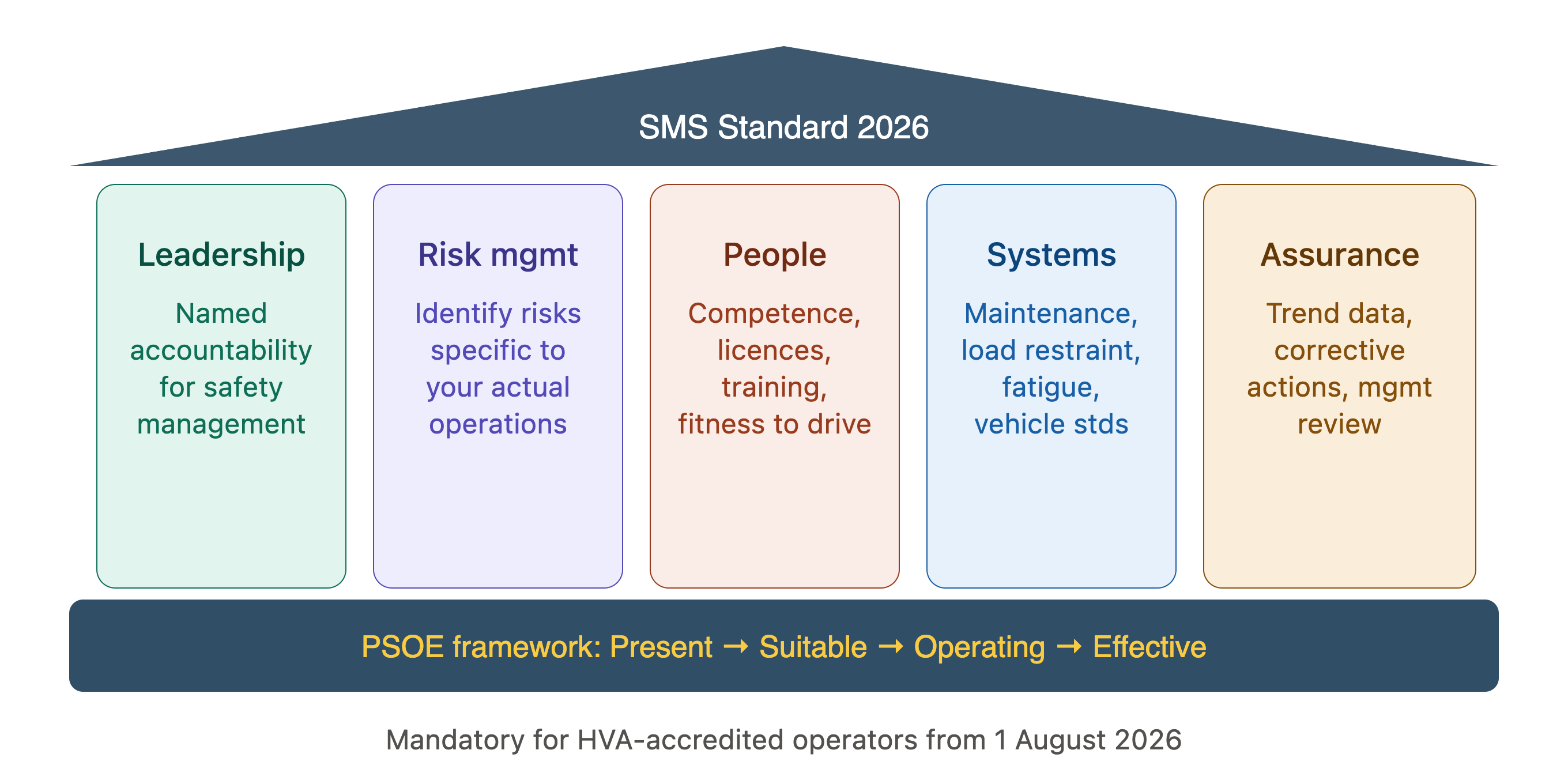
- Leadership and Commitment. Named accountability for safety management within the business. Generic references to “management” are unlikely to satisfy auditors looking for specific, named roles.
- Risk Management. Identification of public risks specific to the operator’s actual transport activities, routes, vehicles, and loads. The NHVR’s guidance indicates that generic hazard lists copied from a template, without reference to actual operations, are unlikely to satisfy the “Suitable” requirement.
- People. Competence, licence verification, induction, ongoing training, and the new fitness-to-drive obligations. Competence records need to be current and accessible.
- Safety Systems. Documented processes for operational controls, including maintenance, load restraint, fatigue management, and vehicle standards.
- Assurance, Monitoring and Improvement. Evidence of continuous improvement: trend data, corrective actions, management review records.
The “Effective” standard in PSOE is where systems that only exist on paper fall short. Auditors can ask floor staff whether they know the relevant procedure. A policy no one follows fails at “Operating.” A policy followed but never reviewed fails at “Effective.”
For operators tracking compliance evidence across multiple vehicles and drivers, Manage Vehicle’s document management and reporting centralises maintenance records, training logs, inspection reports, and work diary data in one platform, so records are retrievable when an auditor requests them.
An SMS is mandatory for operators seeking HVA accreditation. For non-accredited operators, it is not legally required under the HVNL. However, the NHVR’s own FAQ notes that an effective SMS helps demonstrate due diligence and supports compliance with the primary duty. It may assist an operator in demonstrating that they took reasonably practicable steps, but it does not by itself guarantee HVNL compliance or provide an automatic legal defence.
Common Compliance Gaps
The following operational gaps are consistently highlighted in NHVR guidance, audit findings, and enforcement activity:
- Assuming subcontractors hold all CoR liability. Consignors and consignees that subcontract all transport often do not recognise their own CoR duties. The primary duty attaches to the function, not the contract.
- Treating work diaries as the driver’s problem. The driver completes the diary, but the operator needs systems to verify accuracy and identify discrepancies. The NHVR recorded nearly 5,000 fatigue offences in 2025. In March 2026, it launched Operation Ambit, a nationwide enforcement campaign targeting fatigue and work diary breaches, citing what it described as “alarming levels of non-compliance.” Manage Vehicle’s digital work diary timestamps entries and flags discrepancies automatically, replacing the manual cross-checking that paper diaries require.
- Stale risk registers. A risk register last reviewed at the previous accreditation audit is unlikely to reflect current operations. The SMS Standard expects risk management to be an ongoing process, not a periodic exercise.
- No process for unfit-to-drive reports. Many operators have not updated pre-trip processes to cover the full scope of the amended unfit-to-drive duty. A fitness declaration that only addresses fatigue no longer reflects the law.
- Confusing the Master Code with a mandatory checklist. The 2026 Master Code is guidance. It is not an offence to decline a specific control if the operator can demonstrate an alternative approach to managing that risk. The value of the Code is as a resource for identifying hazards and controls relevant to the operation, not as a tick-box exercise.
How CoR Applies Across Industries
CoR is not limited to long-haul transport. Any organisation operating, contracting, scheduling, consigning, or loading heavy vehicles over 4.5 tonnes GVM has duties under the HVNL.
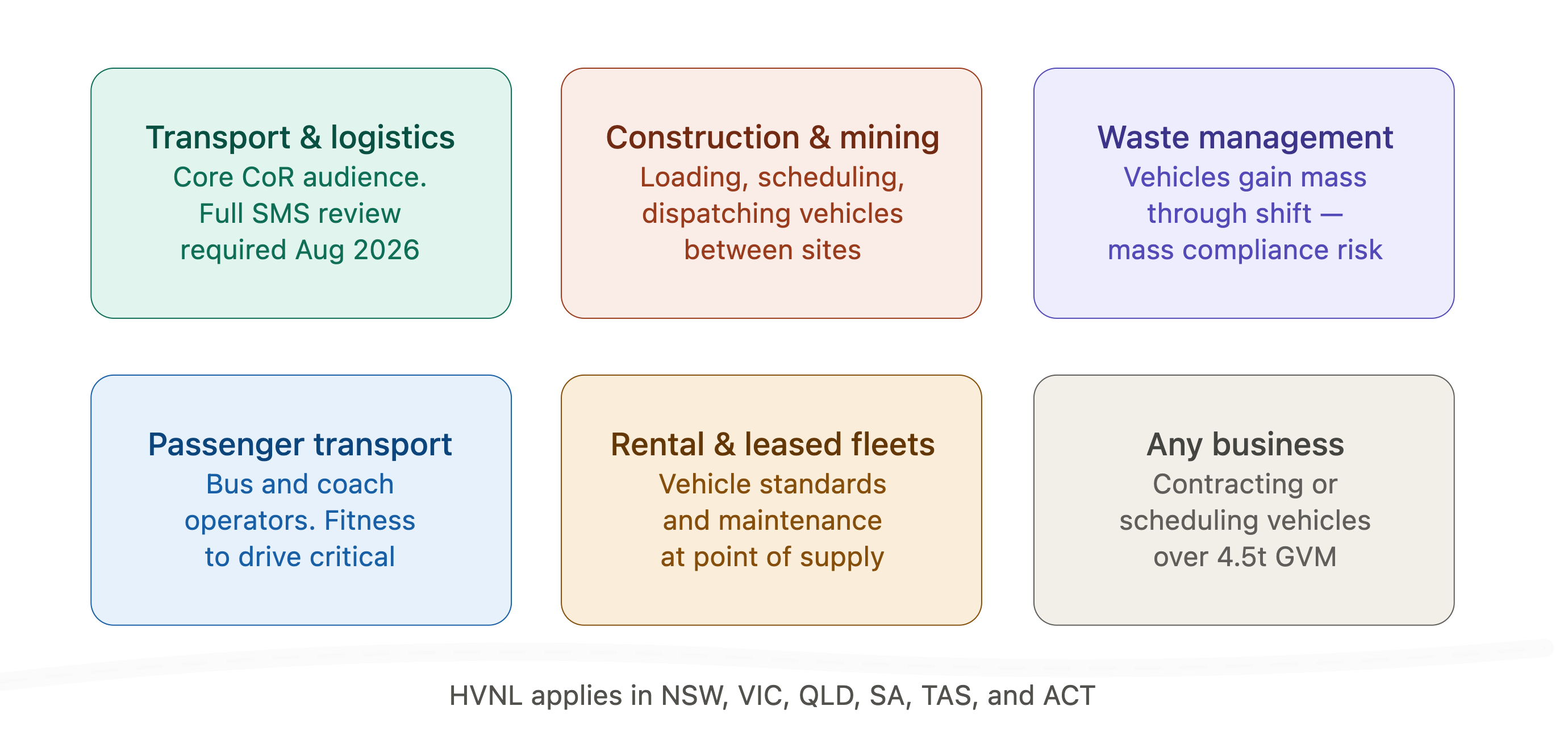
- Transport and logistics. The core audience, and the sector most likely to have existing CoR systems. The 1 August 2026 changes require a full review of SMS documentation, fatigue management procedures, and fitness-to-drive processes.
- Construction and mining. Site operators who load trucks, schedule concrete or aggregate deliveries, or dispatch vehicles between sites carry CoR duties. The NHVR has specifically noted that organisations that own, procure, manage, or contract heavy vehicles, including construction companies, need to take practical steps to manage transport safety risks.
- Waste management. Vehicles that gain mass throughout a shift create specific mass-compliance challenges. Operators need systems to monitor cumulative load across a collection route. Manage Vehicle’s mass management tools track load data against rated limits in real time.
- Passenger transport. Bus and coach operators carry CoR obligations. The expanded fitness-to-drive duty is especially relevant given direct passenger safety implications.
- Rental and leased fleets. Businesses leasing heavy vehicles have CoR obligations around vehicle standards and maintenance at the point of supply.
The HVNL applies in NSW, VIC, QLD, SA, TAS, and ACT. It does not currently apply in WA or NT as state/territory law, though vehicles from those jurisdictions must comply when operating in participating states.
CoR Compliance Checklist: August 2026
This is a baseline review, not legal advice. Each item should be assessed against your specific operations.
- Identify every CoR function your business performs and document who is accountable for each.
- If you are accredited or seeking accreditation, review your SMS against the five SMS Standard 2026 categories. If you are not accredited, consider whether a documented SMS would strengthen your primary duty compliance.
- Update your risk register to reflect current operations, routes, vehicles, and loads.
- Implement a fit-to-drive process covering the full scope of the amended Section 228(1): fatigue, illness, injury, medication, mental health, and substance use. Document the stand-down and replacement driver process.
- Review the 2026 Master Code and record which activities and controls are relevant to your operation and why.
- Review your work diary processes. If you use paper diaries, assess whether a digital work diary would reduce the risk of undetected discrepancies.
- Confirm your executive officers understand their personal due diligence duty under Section 26D.
- Check that subcontractor agreements do not purport to transfer your primary duty. They cannot.
FAQ
What is Chain of Responsibility in Australian transport?
CoR is the part of the HVNL that extends safety liability beyond the driver to every party who controls or influences a heavy vehicle transport activity. Ten party types are identified. Each shares the same primary duty under Section 26C. See the NHVR CoR page for the full list.
What are the maximum CoR penalties in 2026?
Category 1 (reckless conduct): up to $4,230,550 corporate and $436,850 individual, plus up to 5 years imprisonment. Category 2: up to $2,120,880 corporate and $212,090 individual. Category 3: up to $705,820 corporate and $70,580 individual. These are CPI-indexed annually on 1 July. Verify at nhvr.gov.au.
Does CoR apply in WA and the NT?
The HVNL does not currently apply in WA or the NT as state/territory law. Vehicles from those jurisdictions must comply when operating in participating states. WA and NT have their own heavy vehicle regulations.
Is a Safety Management System mandatory?
An SMS is mandatory for operators seeking Heavy Vehicle Accreditation (GSA or ACA) from 1 August 2026. For non-accredited operators, it is not a legal requirement under the HVNL, but the NHVR recommends it as a way to demonstrate due diligence. It does not automatically establish compliance.
What is the 2026 Master Code?
An activity-based guide from the NHVR covering 45 transport activities and over 500 recommended controls. It is not mandatory, but courts may use it as a benchmark when assessing whether a CoR party took reasonably practicable steps.
What does the new “unfit to drive” duty cover?
From 1 August 2026, the duty applies to all heavy vehicles over 4.5 tonnes GVM and covers fatigue, illness, injury, mental health, medication effects, alcohol, and drugs. Drivers can legally refuse to drive when unfit. Operators must have a documented process for handling reports.
Legal disclaimer: This article provides general information about Chain of Responsibility obligations under the Heavy Vehicle National Law. It is not legal advice. Penalty figures are CPI-indexed and change annually. Always verify current requirements against NHVR publications and seek independent legal advice for your specific circumstances.